On this page
- What is hard water?
- How hardness becomes scale
- What hard water can do inside a commercial kitchen
- Early warning signs—and what they do not prove
- Hardness, TDS and alkalinity are not interchangeable
- What to test before selecting treatment
- Which treatment can stop hardness damage?
- A practical seven-step prevention plan
- Example: one kitchen, four different decisions
- Common mistakes that allow scale damage to continue
- Frequently asked questions
- Protect the equipment by specifying the water
- Sources and verification notes
Recurring scale in commercial kitchen equipment calls for a hardness test and a check against the appliance’s water specification. Select treatment for the affected water line—not one solution for every machine.
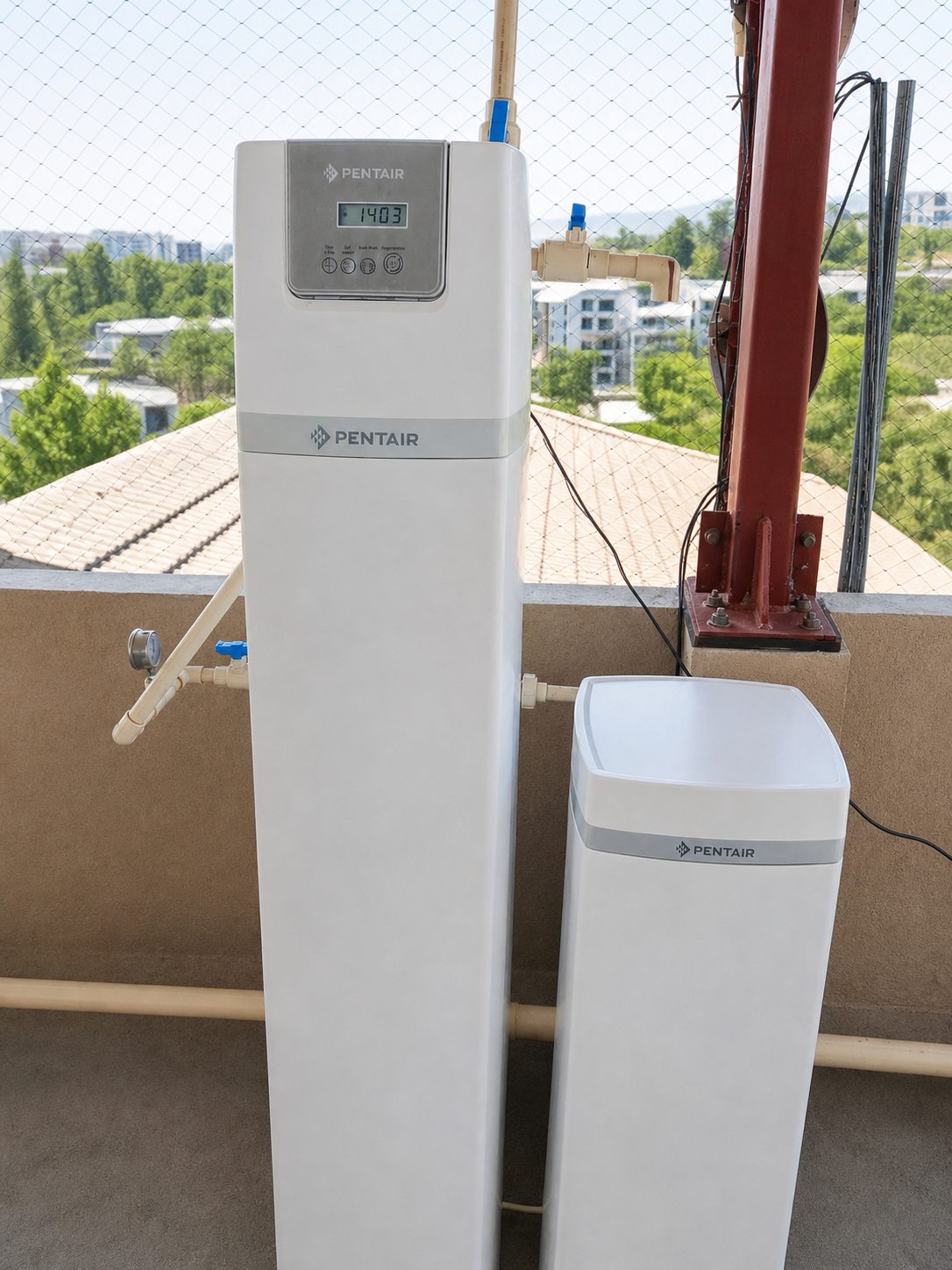
That makes combi ovens, steamers, commercial dishwashers, booster heaters, coffee machines, ice makers, hot-water systems, and their valves and nozzles important inspection points. Where testing confirms hardness is the problem, a correctly sized commercial water softener may form part of the treatment plan.
The correct response is not automatically “install an RO plant” or “soften all water to zero hardness.” It is to test the water, collect the inlet-water requirements for each appliance, map the kitchen’s water circuits, and select treatment that controls scale without creating another water-quality problem.
Hardness is mainly caused by dissolved calcium and magnesium. Heating or evaporation can cause mineral deposits to form on heat-transfer surfaces, sensors, valves, spray jets, pipes, and visible appliance surfaces. Control begins with a laboratory water report and the exact equipment-manufacturer specification. Depending on the result, the solution may be softening, application-specific scale control, RO with blending or remineralisation, another treatment process, or a combination.
What is hard water?
Water hardness is principally associated with calcium and magnesium. It is normally reported as milligrams per litre, or mg/L, as calcium carbonate (CaCO3).
The US Geological Survey uses the following general classification:
| Total hardness as CaCO3 | General USGS description |
|---|---|
| 0-60 mg/L | Soft |
| 61-120 mg/L | Moderately hard |
| 121-180 mg/L | Hard |
| More than 180 mg/L | Very hard |
Source: USGS, Hardness of Water
These bands are useful descriptive language, not commercial-appliance specifications. A machine may require a much narrower water profile.
WHO has not established a health-based guideline value for hardness. Its guideline history notes that water above approximately 200 mg/L as CaCO3 may cause scale deposition in distribution systems, while acceptability varies with local conditions. [Source: WHO hardness guideline history]
India’s drinking-water specification provides a different regulatory context. Government of India material reproducing IS 10500 lists:
- acceptable total-hardness limit: 200 mg/L as CaCO3; and
- permissible limit in the absence of an alternate source: 600 mg/L as CaCO3.
Source: Government of India, Uniform Drinking Water Quality Monitoring Protocol
An important distinction follows:
Water can meet a drinking-water hardness limit and still fall outside the inlet-water requirement of a dishwasher, espresso machine, steam generator, or other appliance.
The IS 10500 permissible limit is not a universal equipment-protection target.
How hardness becomes scale
Groundwater can dissolve calcium and magnesium as it moves through soil and rock. Those dissolved ions are not the same thing as visible sediment.
Under scale-forming conditions—especially heating, evaporation, and changes in carbonate chemistry—part of the dissolved mineral load can precipitate as a solid deposit. The familiar white or off-white deposit is commonly called limescale.
USGS states that heating hard water can form calcium-carbonate deposits. Its technical material also links hard-water scale in boilers, water heaters, and pipes with reduced water flow and heat transfer. [Sources: USGS scale photograph and explanation] and [USGS water-properties reference]
Three kitchen conditions deserve particular attention:
- Heat: hot surfaces can promote precipitation and receive deposits.
- Evaporation or steam generation: water leaves while many dissolved minerals remain behind, increasing their concentration in the residual water.
- Small passages: a deposit that looks minor on an open surface can obstruct a spray jet, solenoid valve, nozzle, probe, or narrow pipe.
Hardness is not the only factor in scale or corrosion. Alkalinity, pH, temperature, concentration, silica, chloride, sulphate, iron, treatment chemistry, metallurgy, and operating cycles can matter. That is why a hardness strip or handheld TDS meter alone cannot define the complete solution.
What hard water can do inside a commercial kitchen
1. Combi ovens and steamers
Steam-producing equipment repeatedly heats and evaporates water. This can concentrate scale-forming minerals in boilers, steam generators, valves, probes, and distribution passages.
Possible operating signs include:
- recurring scale on inspected water-side components;
- longer or more frequent manufacturer-approved cleaning or deliming;
- restricted nozzles or steam passages;
- level-sensing, fill, or drain irregularities; and
- reduced or inconsistent steam production.
Do not prescribe a universal combi-oven hardness target. Requirements differ by manufacturer, model, steam-generation design, cleaning system, and which inlet is being treated.
For example, a RATIONAL installation manual for specified SelfCooking Center and CombiMaster models distinguishes common and treated-water connections, gives model-specific hardness cautions, and recommends a trained-technician check for actual scale buildup after installation. Those instructions belong to the stated equipment generation; they must not be copied blindly to another model. [Source: RATIONAL installation manual]
Control approach: obtain the current installation and water-quality manual for the exact serialised appliance. Test hardness, alkalinity, TDS or conductivity, pH, chloride, silica, iron, and any other parameter the manufacturer requests. Treat the designated inlet only as specified, then commission and monitor it.
2. Commercial dishwashers and warewashers
Warewashing combines hot water, detergents, rinse chemistry, heaters, pumps, wash arms, and small spray openings. Hardness can contribute to lime scale, while water chemistry also affects spotting, detergent performance, staining, and corrosion risk.
Hobart’s LXe-series instruction manual recommends water hardness of 3 grains per US gallon or less for the models covered and states that higher hardness may cause excessive lime-scale formation. It separately flags iron, chloride, sediment, and dissolved solids as possible treatment concerns. A different Hobart CLeN manual bases its delime notification on entered incoming hardness and final-rinse usage. [Sources: Hobart LXe manual] and [Hobart CLeN manual]
Three grains per US gallon is approximately 51 mg/L as CaCO3, using the NIST conversion factor of 17.11806 mg/L per US grain per gallon. That conversion helps Indian readers interpret this particular manual; it is not a universal dishwasher limit. [Source: NIST Guide to the SI conversion factors]
Control approach: match treatment to the exact machine, booster heater, detergent programme, rinse requirement, and source chemistry. Verify final-rinse performance and inspect wash arms and heat-transfer surfaces. Deliming is corrective maintenance, not a substitute for fixing unsuitable incoming water.
3. Espresso and coffee equipment
Coffee equipment creates a balancing problem. Excessive scale-forming mineral content can harm heated water paths, but water that is excessively demineralised or chemically aggressive may also be unsuitable. Mineral composition also affects beverage extraction and taste.
La Marzocco’s published water specification illustrates how narrow an OEM window can be. For the equipment covered, it lists total hardness of 70-100 ppm, alkalinity of 40-80 ppm, TDS of 90-150 ppm, pH 6.5-8, chloride of 0-30 ppm, and limits for iron and chlorine. The manufacturer also warns that ordinary drinking-water filters may have little effect on mineral chemistry and that very pure water can create corrosion or sensor problems. [Source: La Marzocco water specifications]
This example disproves two common assumptions:
- “A carbon filter solves hardness” is generally false; carbon filtration is not automatically a hardness-reduction process.
- “The lowest possible TDS and hardness are always safest” is also false; some equipment requires a controlled mineral profile.
Control approach: test the water at the actual coffee-machine feed. Use the current model specification, not a generic coffee standard. Where RO is necessary, controlled blending or remineralisation may be required to reach the approved profile.
4. Commercial ice machines
An ice maker freezes only part of the incoming water during a cycle. Depending on the machine design, minerals and other dissolved material can become more concentrated in the remaining water and can deposit on water-system components.
Hoshizaki’s current service material links high hardness or impurities with cloudy cubes, lists a scaled water system as a fault to inspect, and recommends filtration or scale treatment where appropriate. Its training guidance says lime or calcium buildup is associated with service issues and that cleaning frequency and external water treatment depend on local water conditions. [Sources: Hoshizaki AM-50 service manual] and [Hoshizaki training guidance]
Scale control does not replace food-safety cleaning and sanitisation. Ice machines have both mineral-management and hygiene requirements.
India’s high ambient temperatures can also affect air-cooled ice-machine performance, but ambient heat and hardness are separate variables. A Hoshizaki model-specific service manual, for example, identifies excessive ambient temperature as a cause of long freeze cycles independently of scale. Do not diagnose every summer capacity problem as hard-water damage. [Source: Hoshizaki AM-50 service manual]
Control approach: confirm inlet-water chemistry, inlet temperature, room temperature, ventilation, condenser condition, purge settings, cleaning records, and the exact manufacturer requirements before changing treatment.
5. Booster heaters, hot-water systems and small passages
Water heaters, booster heaters, heat exchangers, hot-water lines, valves, and spray nozzles may all receive hardness deposits. USGS specifically notes that scale can clog pipes and lower electric-water-heater efficiency. It also documents reduced heat transfer and flow as recognised effects of hard-water scale. [Sources: USGS hardness overview] and [USGS scale explanation]
The operational consequence depends on deposit location and severity. It may appear as restricted flow, uneven spray, slow heat-up, temperature-control problems, repeated heater cleaning, or visible scale at outlets. These signs are not conclusive on their own: sediment, corrosion products, low supply pressure, valve wear, and maintenance problems can look similar.
Early warning signs—and what they do not prove
| Observation | Possible hardness-related mechanism | Other checks before concluding |
|---|---|---|
| White deposit on a heated surface | Mineral precipitation after heating or evaporation | Cleaning residue, process chemicals, actual deposit analysis |
| Blocked spray jets or uneven rinse | Scale in small passages | Sediment, debris, low pressure, pump or valve condition |
| Repeated delime alerts | Incoming hardness and water usage may be driving scale load | Correct hardness setting, sensor condition, manufacturer programme |
| Longer heat-up or poor steam output | Deposit on heat-transfer surface or restricted passage | Heating element, controls, gas/electrical supply, load, ventilation |
| Spots on glassware | Hardness minerals can contribute | Rinse aid, detergent, wash temperature, TDS, drying and operator practice |
| Cloudy ice | Water quality may contribute | Machine cleanliness, freeze cycle, filtration, air flow and operating conditions |
| Coffee-machine scale | Mineral precipitation in heated paths | Alkalinity, total hardness, temperature, treatment bypass and cartridge exhaustion |
A visual symptom is a reason to investigate, not a complete water analysis.
Hardness, TDS and alkalinity are not interchangeable
These three readings answer different questions:
- Total hardness estimates multivalent ions, principally calcium and magnesium, expressed as CaCO3.
- TDS represents the overall dissolved-material concentration by a defined method or estimate. It does not identify which ions are present.
- Alkalinity measures acid-neutralising capacity and is important to carbonate chemistry and beverage-water balance.
Two waters with the same TDS can have different hardness and scaling behaviour. Two waters with the same hardness can have different alkalinity, chloride, silica, or corrosion characteristics.
A handheld conductivity or TDS meter is useful for trending a known stream, but it cannot replace a laboratory report for treatment design. If you want help interpreting the numbers on your own report, read our guide on how to read a commercial water-test report.
What to test before selecting treatment
For a commercial-kitchen scale-risk review, begin with a representative sample from each actual source: municipal supply, borewell, tanker, or blended storage. Where an existing treatment plant is involved, sample both upstream and at the point of use.
The required panel depends on the appliance and source, but commonly includes:
- total hardness as CaCO3;
- calcium and magnesium where a detailed ionic picture is needed;
- total alkalinity as CaCO3;
- pH;
- electrical conductivity and laboratory TDS;
- chloride and sulphate;
- silica for relevant steam, heating, and membrane applications;
- iron and manganese;
- turbidity and suspended material;
- free and total chlorine where relevant to carbon, membranes, beverages, or the OEM limit; and
- microbiological parameters for potable, food-contact, beverage, and ice applications.
FSSAI’s foodservice hygiene framework requires potable water meeting IS 10500 where water is used as an ingredient or contacts food or food-contact surfaces, subject to the checklist’s testing and municipal-supply provisions. Equipment protection is an additional requirement; it does not replace potability. [Source: FSSAI Food Service Establishment Hygiene Rating Checklist]
Which treatment can stop hardness damage?
No single process is correct for every kitchen.
Sediment filtration
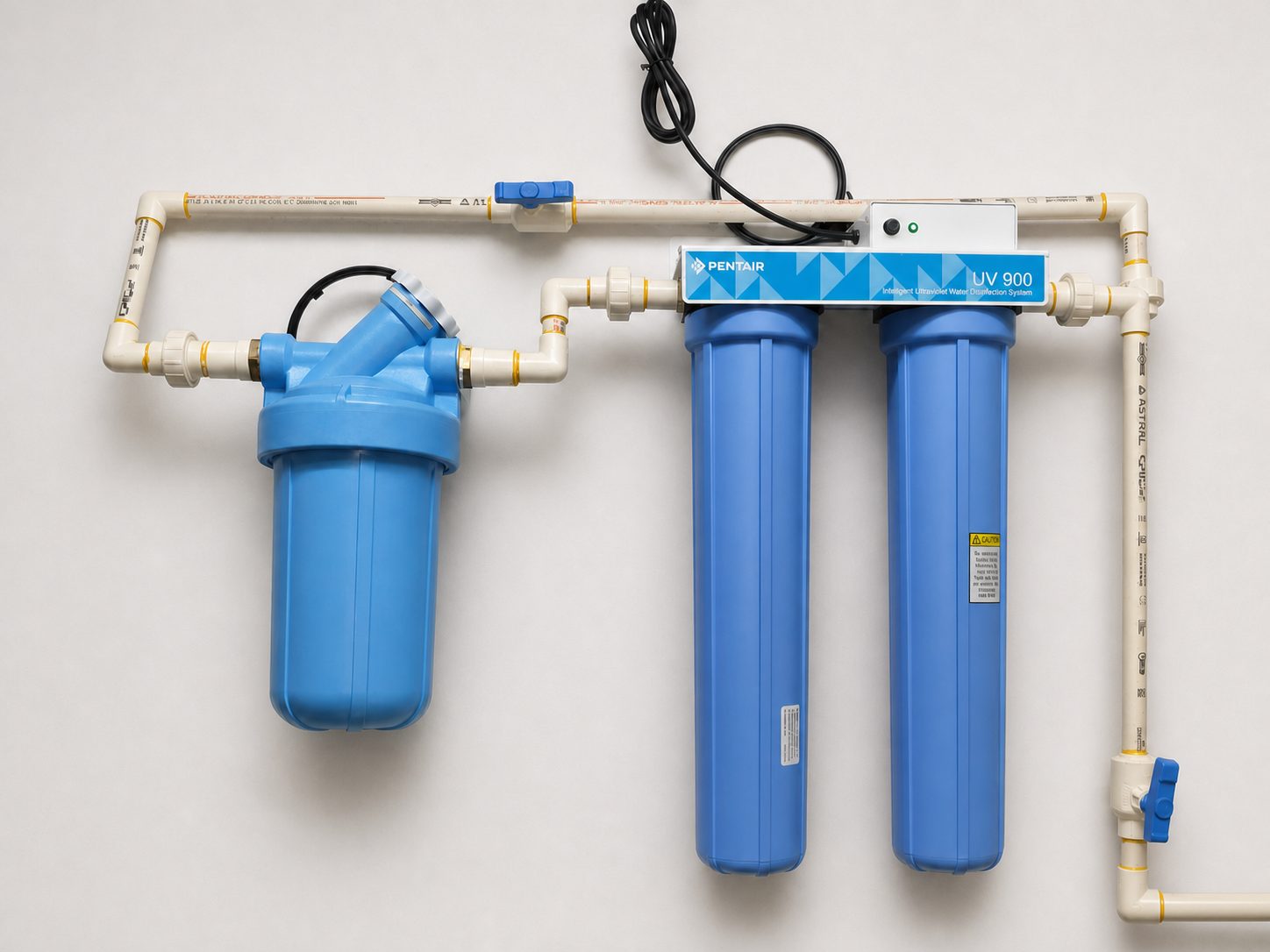
Sediment filters can reduce particles within their stated performance range. They can protect small openings from grit and suspended matter, but they do not normally remove dissolved calcium and magnesium. A clear-looking outlet can still be hard.
Activated-carbon filtration
Activated carbon is commonly used for chlorine, taste, odour, and specified organic-reduction duties. A standard carbon cartridge is not automatically a water softener. Check the product’s certified or stated claims.
Ion-exchange softening
A conventional sodium-cycle softener exchanges calcium and magnesium for sodium. It can provide low-hardness water at commercial flow rates when correctly sized, regenerated, monitored, and maintained.
It does not function as broad demineralisation, does not automatically reduce TDS, and does not make microbiologically unsafe water potable. Its design must include peak flow, hardness load, resin capacity, salt and regeneration water, brine drainage, redundancy, and outlet-hardness monitoring. [Sources: DuPont, Fundamentals of Ion Exchange] and [NSF/ANSI 44 technical requirements]
Scale-control cartridges or media
Some point-of-use products are designed to inhibit or manage scale rather than remove hardness. Their mechanism, dose, temperature limit, flow, capacity, food-contact suitability, and appliance compatibility vary. An inlet hardness test may remain high even when the product is operating as designed, because inhibition is not the same as ion removal.
Only use such a product where its documented performance and the equipment manufacturer support the application.
Reverse osmosis
RO can reduce hardness and many other dissolved constituents, but it also produces concentrate and needs suitable pretreatment, pressure, recovery control, storage, and hygiene. Very low-mineral permeate may require blending or remineralisation for beverage quality, corrosion control, or equipment sensors.
The US EPA describes RO as effective for many dissolved contaminants while noting concentrate generation, energy demand, pretreatment, and possible post-treatment corrosion control. [Source: US EPA treatment-technology overview]
RO should therefore be selected for a defined product-water requirement—not simply because scale is visible. For a longer side-by-side view of the two processes, see our comparison of a water softener and an RO plant.
Separate treatment by application
One kitchen may rationally have more than one treated-water circuit:
- softened water for an approved warewashing or hot-water duty;
- application-specific conditioned water for a combi oven or steamer;
- controlled-mineral water for espresso;
- appropriately filtered and hygienically managed water for ice; and
- untreated or differently treated water for uses that do not need the same quality.
This is often safer and more resource-efficient than forcing every appliance onto one assumed water specification.
A practical seven-step prevention plan
Step 1: Build an equipment register
Record make, model, serial number, water connection, peak flow, operating hours, current filtration, service history, and visible symptoms for every water-using appliance.
Step 2: Collect current manufacturer requirements
Use the installation or water-quality manual for the exact model and market. Record hardness, alkalinity, TDS, pH, chloride, silica, chlorine, iron, pressure, temperature, flow, and any mandatory treatment or cleaning condition.
Step 3: Map the water system
Trace municipal, borewell, tanker, storage, existing treatment, hot-water, and point-of-use lines. Check bypasses and unlabelled cross-connections. A perfectly selected cartridge cannot protect an appliance if untreated water bypasses it.
Step 4: Test representative water
Use an appropriate laboratory and sample the source and point of use. If sources change, characterise each source and the blends actually supplied.
India’s CGWB reports demonstrate that groundwater quality is location-specific and that some measured parameters change between pre- and post-monsoon sampling. That evidence supports site- and season-aware verification; it does not justify assuming that hardness always rises or falls after the monsoon. [Source: CGWB Annual Ground Water Quality Report 2025]
Step 5: Select and size the treatment train
Match the process to the verified gap between incoming and required water. Size it for peak flow, daily load, pressure, temperature, operating hours, service capacity, regeneration or cartridge change, storage, drainage, and continuity.
Step 6: Commission with measurements
Record raw- and treated-water hardness, conductivity or TDS where relevant, pressure, flow, treatment settings, bypass status, and appliance inlet quality. Commissioning should demonstrate the promised result under real operating conditions.
Step 7: Monitor and maintain
Create a log for inlet and outlet water quality, cartridge throughput, softener salt and regeneration, RO flows and conductivity, pressure drop, cleaning, deliming, sanitisation, alarms, and service observations.
Use only manufacturer-approved cleaning and deliming procedures. Acids and cleaners can create chemical, food-safety, material-compatibility, and warranty risks if used incorrectly.
Example: one kitchen, four different decisions
Consider a hypothetical restaurant supplied by borewell water with laboratory hardness of 320 mg/L as CaCO3. The site has a rack dishwasher, combi oven, espresso machine, and ice maker.
That single hardness value is enough to flag scale risk, but not enough to finalise treatment.
- The dishwasher manual may require substantially lower hardness and may justify a correctly sized soft-water circuit.
- The combi oven must be checked against its own inlet specification, including parameters beyond hardness.
- The espresso machine may need a controlled hardness, alkalinity, TDS, chloride, and pH window—not simply zero-hardness water.
- The ice machine also needs potable water, hygienic maintenance, adequate ventilation, and verification of its own water-quality conditions.
The final design could use separate treatment branches, but only after the complete report, peak flows, OEM manuals, and waste routes are reviewed. The example is not a treatment prescription or a DhwaNeer project claim.
Common mistakes that allow scale damage to continue
- Using TDS as a hardness reading. TDS does not identify calcium and magnesium.
- Treating IS 10500 as an appliance manual. Potability limits and equipment limits serve different purposes.
- Installing a carbon filter for hardness without a supported hardness claim. Carbon and softening are different processes.
- Softening every circuit to the lowest possible hardness. Some coffee, steam, sensor, material, or product-water requirements need a controlled mineral profile.
- Installing RO for the whole kitchen without a water balance. RO produces concentrate and may be unnecessary for high-flow utility duties.
- Ignoring bypass valves and mixed sources. Intermittent untreated water can undo the protection.
- Changing cartridges by calendar alone. Capacity depends on water quality, throughput, and the product’s design basis.
- Deliming without correcting incoming water. Cleaning removes existing deposits but does not change the next litre of feed water.
- Confusing scale control with sanitation. Mineral treatment does not replace cleaning, disinfection, or potable-water compliance.
- Blaming hardness for every fault. Ambient heat, sediment, pressure, electrical supply, ventilation, controls, detergents, and maintenance also matter.
Frequently asked questions
Does hard water damage commercial kitchen equipment?
Hard water can form mineral scale, particularly in heated, evaporative, and small-passage equipment. The effect depends on the complete chemistry, temperature, appliance design, usage, and maintenance.
What hardness is safe for a commercial kitchen?
There is no single commercial-kitchen limit. India lists 200 mg/L as CaCO3 as the acceptable drinking-water hardness limit, but individual appliances may require a different and much narrower range. Follow the exact OEM specification.
Is TDS the same as hardness?
No. Hardness is primarily associated with calcium and magnesium. TDS is a broader measure of dissolved material and does not reveal the ionic composition.
Will a sediment or carbon filter remove hardness?
Not normally. Sediment filtration targets particles; activated carbon targets specified taste, odour, chlorine, or organic concerns. Hardness reduction requires a process with a supported hardness-reduction function.
Is a water softener better than RO for kitchen scale?
Neither is universally better. A softener specifically targets calcium- and magnesium-related hardness at commercial flows. RO reduces a broader dissolved load but creates concentrate and may require post-treatment. Choose from the required product water and operating constraints.
Can softened water feed a coffee machine?
Only if the resulting water meets that machine’s full specification. Hardness, alkalinity, TDS, pH, chloride, sodium, and other parameters may matter. Do not assume zero-hardness water is correct.
How often should commercial equipment be delimed?
Follow the current manufacturer procedure and actual operating evidence. There is no defensible universal interval because scale load depends on water chemistry, temperature, throughput, machine design, purge cycles, and treatment performance.
Can scale be prevented permanently?
Scale risk can be controlled, but treatment needs monitoring and maintenance. Exhausted cartridges, empty softener salt tanks, incorrect regeneration, membrane problems, bypasses, or a changed source can allow the risk to return.
Protect the equipment by specifying the water
The most reliable prevention sequence is simple:
- identify every water-using appliance;
- obtain each current OEM water specification;
- test every real source and relevant seasonal condition;
- separate potability, scale, corrosion, taste, sediment, and microbiological objectives;
- design treatment by application and peak demand;
- verify performance during commissioning; and
- maintain evidence through water-quality and service logs.
DhwaNeer designs and executes commercial softening, RO, filtration, pumping, disinfection, and turnkey water-treatment systems for restaurants, hotels, commercial kitchens, corporate facilities, institutions, and utilities.
Sources and verification notes
This article was fact-checked on 18 July 2026 using Indian government and food-safety material, international public-health and scientific references, treatment standards, and original equipment-manufacturer documents. Manufacturer limits in this article are examples tied to the cited machines or document families; the current manual for the exact installed model remains authoritative.
- Government of India: Uniform Drinking Water Quality Monitoring Protocol
- Bureau of Indian Standards: IS 10500 Drinking Water Specification
- FSSAI: Food Service Establishment Hygiene Rating Checklist
- Central Ground Water Board: Annual Ground Water Quality Report 2025
- WHO: Hardness chemical fact sheet
- WHO: History of hardness guideline development
- US Geological Survey: Hardness of Water
- US Geological Survey: Lime-scale formation in heated hard water
- US Geological Survey: Water properties and hardness effects
- RATIONAL: SelfCooking Center and CombiMaster installation manual
- Hobart: LXe-series dishwasher instruction manual
- Hobart: CLeN-series dishwasher instruction manual
- La Marzocco: Water specifications
- Hoshizaki: AM-50 service manual
- Hoshizaki: Training and cleaning guidance
- NSF/ANSI 44: Technical requirements for cation-exchange softeners
- DuPont: Fundamentals of Ion Exchange
- US EPA: Overview of Drinking Water Treatment Technologies
- NIST: Guide to the SI conversion factors