On this page
- Water softener vs RO at a glance
- What is hardness?
- What is TDS—and why is it not the same as hardness?
- How a commercial water softener works
- How a commercial RO plant works
- The central difference: exchange vs separation
- When a water softener is usually the better process to evaluate
- When an RO plant is usually the better process to evaluate
- When both a softener and RO may be required
- When neither softening nor RO is the first answer
- Indian drinking-water limits are not equipment-design limits
- Three illustrative decision scenarios
- How to size a commercial water softener
- How to size a commercial RO plant
- Compare the operating obligations
- Is softened water safe to drink?
- Questions to answer before choosing
- Frequently asked questions
- Select the process from the problem—not the product label
- Sources and verification notes
A water softener and a reverse-osmosis plant solve different water-quality problems.
A conventional ion-exchange commercial water softener targets hardness, primarily calcium and magnesium. A commercial RO plant uses pressure and a semi-permeable membrane to reduce a much broader range of dissolved constituents. Some facilities need one, some need both, and some need neither.
The right choice depends on a complete water analysis, the intended application, peak flow, required treated-water quality, operating conditions, and the waste stream the site can manage.
Choose a softener when the verified problem is hardness and the application needs scale control or soft water. Evaluate RO when the requirement is broader dissolved-solids or specific-ion reduction. Use both when softening is needed for one circuit or as justified RO pretreatment—but never select either from TDS alone.
Water softener vs RO at a glance
| Question | Water softener | Reverse-osmosis plant |
|---|---|---|
| Primary purpose | Reduce calcium- and magnesium-related hardness | Reduce a broad range of dissolved constituents through membrane separation |
| Main process | Cation exchange | Pressure-driven membrane separation |
| Main output | Softened water | Permeate or product water |
| Main residual stream | Regeneration brine and rinse water | Concentrate or reject water |
| Does it target hardness? | Yes | RO can reject hardness ions, subject to membrane and system design |
| Does it generally reduce overall TDS? | No; it exchanges ions rather than functioning as a demineralisation process | Yes, where the selected membrane and operating design are suitable |
| Does it disinfect water? | No | RO is not a complete disinfection and distribution-hygiene programme |
| Does it remove sediment? | Not its primary function; pretreatment may be required | Pretreatment is commonly required to control particulate fouling |
| Typical commercial role | Hot-water systems, warewashing, laundry, equipment protection, RO pretreatment | Drinking/process-water production, beverage/steam applications, dissolved-solids control |
| Design basis | Hardness load, peak flow, resin capacity, regeneration and continuity | Complete feed chemistry, permeate demand, recovery, pressure, temperature, membrane projection and storage |
The table describes typical functions. Actual contaminant reduction must be supported by the selected product's specification, certification, and design conditions.
What is hardness?
Water hardness is primarily associated with dissolved calcium and magnesium. The US Geological Survey describes hard water as water high in these dissolved minerals and notes that hardness can contribute to mineral buildup in plumbing, fixtures, and water heaters and can reduce soap and detergent performance. [Source: USGS, Hardness of Water]
WHO has not established a health-based guideline value for hardness. Its technical history notes that hardness above approximately 200 mg/L as calcium carbonate may cause scale deposition in distribution systems, while public acceptability varies with local conditions. [Source: WHO hardness guideline history]
India nevertheless specifies hardness limits for drinking-water acceptability. Government of India material reproducing IS 10500 lists:
- Total hardness acceptable limit: 200 mg/L as CaCO3
- Permissible limit in the absence of an alternate source: 600 mg/L as CaCO3
Source: Government of India, Uniform Drinking Water Quality Monitoring Protocol
The permissible limit is not automatically an ideal target for a commercial appliance. A boiler, combi oven, dishwasher, coffee machine, ice machine, heat exchanger, or laundry process may require substantially different water quality under its manufacturer or process specification.
What is TDS—and why is it not the same as hardness?
Total dissolved solids, or TDS, represents dissolved material in water. Hardness-causing calcium and magnesium may contribute to TDS, but TDS can also include sodium, chloride, sulphate, bicarbonate, nitrate, and other dissolved constituents.
This means:
- water can have high hardness without exceptionally high TDS;
- water can have high TDS but relatively low hardness; and
- two samples with the same TDS can have different ion composition and treatment requirements.
IS 10500 lists a TDS acceptable limit of 500 mg/L and a permissible limit of 2,000 mg/L in the absence of an alternate source. These are drinking-water specification values, not universal equipment limits. [Source: Government of India drinking-water protocol]
WHO has not proposed a health-based guideline value for TDS; its guidance discusses TDS mainly in relation to taste, acceptability, and operational effects such as scaling. Specific dissolved constituents can still have their own health-based limits. [Source: WHO drinking-water acceptability guidance]
TDS must therefore be read with the full chemical and microbiological report.
How a commercial water softener works
In a conventional sodium-cycle softener, hard water passes through a vessel containing cation-exchange resin. Calcium and magnesium ions are retained by the resin and exchanged for sodium ions. When the resin's usable capacity is exhausted, it is regenerated with sodium-chloride brine and rinsed before returning to service.
DuPont's ion-exchange technical guidance describes water softening as the interchange of hardness for sodium on the resin. NSF/ANSI 44 similarly covers cation-exchange softeners regenerated with sodium or potassium chloride that reduce calcium- and magnesium-related hardness. [Sources: DuPont, Fundamentals of Ion Exchange] and [NSF/ANSI 44 technical requirements]
What a softener is designed to do
- reduce calcium- and magnesium-related hardness;
- provide soft water at a specified peak flow;
- protect hardness-sensitive downstream applications when correctly sized and maintained; and
- regenerate its exchange capacity using a controlled brine and rinse cycle.
What a conventional softener does not automatically do
- reduce overall TDS as a demineralisation process;
- remove every chemical contaminant;
- disinfect microbiologically unsafe water;
- remove all sediment, turbidity, taste, odour, iron, or manganese under every condition; or
- prove drinking-water compliance.
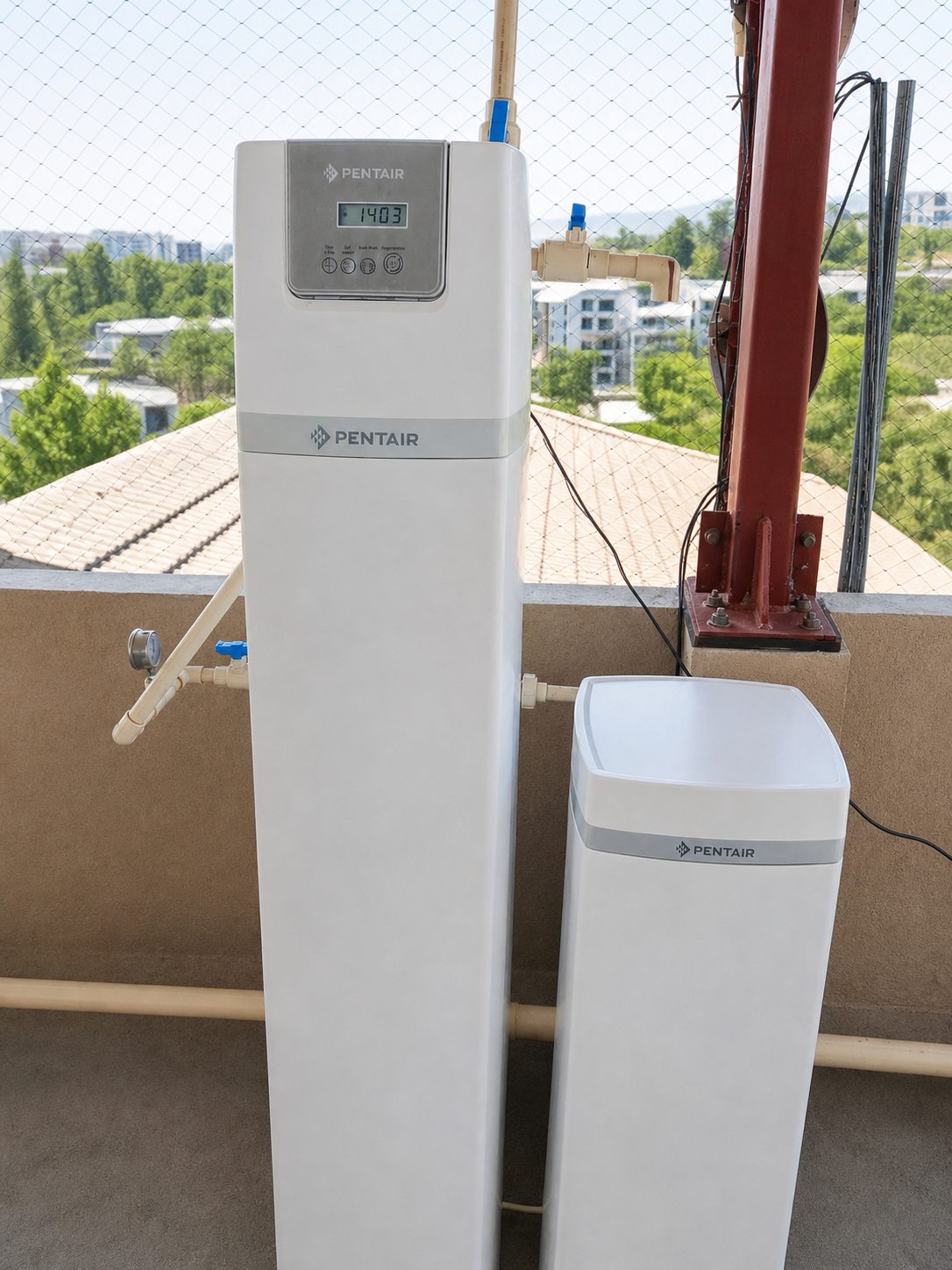
Pentair's foodservice guidance states plainly that a softener exchanges hard ions rather than filtering water. NSF also notes that systems under its softener standard are not intended for microbiologically unsafe water without adequate disinfection. [Sources: Pentair ion-exchange softening guidance] and [NSF standard scope explanation]
How a commercial RO plant works
RO applies pressure to feed water and forces part of it through a semi-permeable membrane. The process creates:
- permeate, the treated product stream; and
- concentrate, the stream containing a higher concentration of many rejected constituents.
The US EPA describes RO and nanofiltration as membrane processes useful for reducing many inorganics, dissolved solids, radionuclides, and synthetic organic chemicals. It also notes their limitations: concentrate production, pressure-related energy use, frequent need for pretreatment, and possible need for post-treatment corrosion control. [Source: US EPA treatment-technology overview]
What RO is designed to do
- reduce a broad range of dissolved constituents where supported by membrane performance;
- produce a defined permeate flow and quality under stated feed and operating conditions;
- separate product water from a concentrate stream; and
- support applications requiring controlled dissolved-solids or ion levels.
What RO does not automatically do
- deliver the catalogue flow under every feed temperature, TDS, pressure, and recovery;
- remain free from scaling, fouling, oxidation, or biofouling without suitable pretreatment and operation;
- guarantee that every contaminant is removed to a safe level;
- preserve microbiological quality in an unhygienic tank or distribution network; or
- eliminate the need for post-treatment, blending, disinfection, or remineralisation where the application requires them.
The central difference: exchange vs separation
A softener replaces selected hardness ions with other ions held by the resin. It changes the ionic composition but is not intended as a broad demineralisation process.
RO separates water into a lower-dissolved-solids permeate stream and a more concentrated reject stream. Its performance depends on membrane selection, pressure, temperature, feed composition, recovery, staging, and pretreatment.
That is why a softener can produce water with very low hardness while a TDS reading remains broadly similar. It is also why an RO plant can reduce hardness and TDS but may require scale control upstream to operate sustainably.
When a water softener is usually the better process to evaluate
Evaluate softening when:
- laboratory testing confirms hardness as the main operational issue;
- equipment requires low-hardness water but not necessarily low TDS;
- scale appears in hot-water systems, dishwashers, warewashing, laundry, or other hardness-sensitive applications;
- a high continuous flow of soft water is required;
- softening is justified as RO pretreatment; or
- separate utility and product-water circuits can avoid unnecessary RO treatment.
For restaurants and hotels, potential soft-water circuits include:
- hot-water generation;
- warewashing and dishwashing where the equipment specification requires it;
- laundry;
- selected ice, steam, or kitchen equipment subject to manufacturer requirements;
- guest-room or facility water where the project specification calls for softening; and
- feed to an RO plant where the membrane design requires hardness control.
The word “potential” matters. Check each appliance's inlet-water specification. Some beverage applications need a controlled mineral profile rather than maximum softening.
When an RO plant is usually the better process to evaluate
Evaluate RO when:
- verified TDS or specific dissolved ions exceed the applicable product-water requirement;
- the application requires a defined low-conductivity or low-dissolved-solids stream;
- potable or process-water quality cannot be met by filtration and softening alone;
- a beverage, ice, steam, boiler, or manufacturing application has a justified membrane-treatment requirement;
- a source contains a membrane-treatable contaminant that requires validated reduction; or
- blending RO permeate with another approved stream is part of an engineered mineral-control strategy.
RO selection still requires a complete feed analysis. A TDS value alone does not reveal scaling ions, silica, iron, organic load, turbidity, SDI, oxidants, microbiological risk, or the product quality achievable at the intended recovery.
When both a softener and RO may be required
Both processes can appear in the same project for two different reasons.
1. Separate application circuits
A hotel may use softened water for hot-water, laundry, or guest-room circuits and RO permeate for selected kitchens, beverages, ice, or another product-water application.
A restaurant may use softened water for warewashing or hot-water equipment and RO-conditioned water for a steam or beverage application with a different specification.
This avoids treating every litre to the same quality when the uses differ.
2. Softener as RO pretreatment
Hardness ions can form sparingly soluble scale as water becomes concentrated in an RO system. A softener may be used upstream to reduce calcium and magnesium where the membrane projection and operating strategy justify it.
Softening is not the only scale-control method. Depending on chemistry and scale risk, a designer may evaluate antiscalant dosing, pH adjustment, lower recovery, lime softening, nanofiltration, or another approach. DuPont's current FilmTec manual discusses multiple scale-control strategies and states that operating variables may need adjustment where other methods do not prevent precipitation. [Source: DuPont FilmTec RO/NF Technical Manual]
The pretreatment choice should come from a membrane projection—not a blanket rule that every RO plant needs a softener.
When neither softening nor RO is the first answer
Some common water problems point elsewhere.
| Verified problem | Process to investigate first | Why softener or RO alone may be insufficient |
|---|---|---|
| Sediment or elevated turbidity | Source correction, tank cleaning, media or cartridge filtration | A softener is not a sediment filter; RO needs particulate control |
| Chlorine-related taste or application dechlorination | Activated carbon or another validated dechlorination method | Softening does not target chlorine; RO membranes may require oxidant protection |
| Microbiological contamination | Sanitary investigation, source protection, disinfection and verification | Neither device replaces a water-safety plan and hygienic distribution |
| Iron or manganese | Determine dissolved/particulate form and evaluate oxidation, filtration, media or membrane treatment | Chemistry and oxidation state govern the solution |
| Low pressure or fluctuating flow | Pumping, storage and distribution assessment | Water quality equipment does not correct an undersized hydraulic system |
| Taste or odour | Identify the compound or source | Hardness/TDS may not be the cause |
Do not use a softener or RO plant as a generic response to “bad water.” Test the water and define the problem.
Indian drinking-water limits are not equipment-design limits
IS 10500 distinguishes acceptable limits from higher permissible limits available for certain parameters only in the absence of an alternate source.
| Parameter | Acceptable limit | Permissible limit in absence of alternate source |
|---|---|---|
| Total hardness as CaCO3 | 200 mg/L | 600 mg/L |
| TDS | 500 mg/L | 2,000 mg/L |
| pH | 6.5-8.5 | No relaxation |
| Turbidity | 1 NTU | 5 NTU |
| E. coli or thermotolerant coliforms | Not detectable in 100 mL | Not detectable in 100 mL |
Source: Government of India, Uniform Drinking Water Quality Monitoring Protocol
These values help assess drinking-water acceptability. They do not guarantee compliance with a combi oven, boiler, coffee machine, ice machine, dishwasher, or laundry specification.
For water used as an ingredient or in contact with food or food-contact surfaces, FSSAI food-service hygiene material requires potable water meeting IS 10500 and contains testing and record provisions based on the supply arrangement. [Sources: FSSAI hygiene requirements] and [FSSAI Food Service Establishment Hygiene Rating Checklist]
Three illustrative decision scenarios
The following examples are fictional. They demonstrate reasoning only and are not treatment prescriptions or DhwaNeer project results. Potability cannot be declared without the complete report.
Scenario A: High hardness, TDS within the acceptable limit
| Parameter | Illustrative result |
|---|---|
| Total hardness | 420 mg/L as CaCO3 |
| TDS | 470 mg/L |
Initial reading:
- hardness is above the 200 mg/L acceptable limit but below the 600 mg/L permissible limit in the absence of an alternate source;
- TDS is below the 500 mg/L acceptable limit; and
- a softener may be appropriate to evaluate for a hardness-sensitive application.
What cannot be concluded:
- that the water is potable without the rest of the report;
- that RO is unnecessary for every application; or
- the required softener size without peak flow and hardness-load calculations.
Scenario B: TDS above acceptable, moderate hardness
| Parameter | Illustrative result |
|---|---|
| Total hardness | 160 mg/L as CaCO3 |
| TDS | 1,200 mg/L |
Initial reading:
- hardness is within the 200 mg/L acceptable limit;
- TDS is above the acceptable limit but below the permissible limit available in the absence of an alternate source; and
- a conventional softener would not be expected to solve the broader TDS requirement.
The next step is to identify the dissolved-ion composition and application target. RO or another process may be evaluated, but TDS alone does not complete the design.
Scenario C: High hardness and high TDS
| Parameter | Illustrative result |
|---|---|
| Total hardness | 480 mg/L as CaCO3 |
| TDS | 1,400 mg/L |
Initial reading:
- both values are above their acceptable limits;
- RO may be evaluated for the dissolved-solids objective;
- softening may be evaluated for a separate circuit or as justified RO pretreatment; and
- the final treatment train must be based on complete ionic chemistry, scaling risk, product specification, recovery, and waste management.
None of the three scenarios supports buying equipment from two numbers alone.
How to size a commercial water softener
A softener is not sized by tank diameter alone. The design needs:
- raw-water hardness at the design condition;
- peak and continuous service flow;
- daily softened-water demand;
- required treated-water hardness or allowable leakage;
- resin type and working exchange capacity at the selected salt dose;
- acceptable pressure drop;
- regeneration water and salt requirement;
- available regeneration time and drain capacity;
- iron, manganese, turbidity and other constituents that may foul resin; and
- continuity requirement during regeneration.
Hardness load is commonly expressed as:
Daily hardness load = daily softened-water volume × feed-water hardness
Use consistent units and the resin manufacturer's engineering data when converting that load into usable resin capacity and regeneration frequency.
For operations that need uninterrupted soft water, a twin-alternating or duplex arrangement may be evaluated. The choice must be based on required flow during regeneration and failure—not simply the presence of two vessels.
How to size a commercial RO plant
RO capacity is based on:
- daily and peak permeate demand by application;
- effective production hours;
- usable product-water storage;
- complete feed chemistry and temperature range;
- membrane projection;
- recovery and concentrate flow;
- pretreatment and downtime;
- product-water target; and
- redundancy requirement.
The basic first-pass formula is:
Required average permeate flow (LPH) = daily RO-product demand ÷ effective production hours
That result must be checked against peak demand, storage, winter or minimum-temperature output, membrane limits, and concentrate management.
Compare the operating obligations
| Operating requirement | Water softener | RO plant |
|---|---|---|
| Routine inputs | Regenerant salt or potassium chloride where designed; water for regeneration and rinse | Electricity; pretreatment consumables or chemicals; cleaning chemicals where required |
| Waste stream | Brine containing displaced hardness ions, residual regenerant and rinse water | Concentrate containing elevated levels of many rejected feed constituents |
| Key monitoring | Feed and outlet hardness, service volume, salt level, regeneration, pressure drop | Feed/permeate/concentrate flow, pressure, recovery, conductivity/TDS, differential pressure, pretreatment condition |
| Common failure risks | Resin fouling, salt bridging, valve or injector problems, hardness leakage, poor rinse | Scaling, particulate/organic/biofouling, oxidation, pressure problems, membrane damage |
| Sanitary responsibility | Tank, resin, piping and distribution hygiene | Pretreatment, membrane, permeate tank and distribution hygiene |
The US EPA notes that cation-exchange softeners consume water and salt during regeneration. It also notes that RO creates a concentrate stream requiring management. [Sources: US EPA cation-exchange softeners] and [US EPA RO overview]
The lower-capital-cost option is not necessarily the lower-lifecycle-cost option. Compare source water, equipment, salt, water, electricity, consumables, labour, downtime, waste handling, and service—not only purchase price.
Is softened water safe to drink?
“Softened water is never drinkable” and “softened water is automatically potable” are both incorrect statements.
A softener addresses hardness; it does not establish the safety of the source. Potability depends on the complete chemical and microbiological quality, the treatment materials and operation, sodium or potassium introduced by the exchange process, distribution hygiene, and compliance with applicable requirements.
WHO has not set a health-based guideline value for hardness, but it notes that drinking water can contribute calcium and magnesium and that mineral composition should be considered when water is modified or demineralised. [Source: WHO hardness chemical fact sheet]
For any drinking or food application, obtain a complete water analysis and qualified review. People subject to medically prescribed sodium or potassium restrictions should follow clinical advice rather than a generic water-treatment claim.
Questions to answer before choosing
- What is the verified hardness as CaCO3?
- What is the TDS and complete ionic composition?
- Are microbiological indicators absent in the relevant potable sample?
- What specific application needs treated water?
- What does the equipment manufacturer require?
- Is the objective potability, scale control, dissolved-solids reduction, taste, process quality, or several objectives?
- What are the daily and peak flows?
- Can the operation stop for softener regeneration or RO maintenance?
- What raw- and treated-water storage exists?
- Where will regeneration brine or RO concentrate go?
- How variable is the source between municipal, tanker, borewell, pre-monsoon, and post-monsoon conditions?
- What results will be demonstrated at commissioning?
Frequently asked questions
Does a water softener reduce TDS?
A conventional sodium-cycle softener is designed to exchange calcium and magnesium for sodium. It is not a broad demineralisation process and should not be selected to reduce overall TDS.
Does RO remove hardness?
RO membranes can reject calcium and magnesium along with many other dissolved ions. However, hardness can create scaling risk as feed becomes concentrated, so pretreatment and recovery must be engineered.
Can a softener replace an RO plant?
Only when the actual requirement is hardness reduction and no broader dissolved-solids or contaminant reduction is needed. It cannot be assumed to replace RO for a low-TDS or specific-ion application.
Can RO replace a softener?
RO can produce low-hardness permeate, but using RO for every soft-water application may be unnecessary. A softener may also be needed upstream or on a separate high-flow circuit. Compare water quality, flow, recovery, waste, and lifecycle operation.
Which is better for a hotel?
Neither is universally better. Hotels often have different circuits. Softening may suit hot water, laundry, or selected utility loads, while RO may suit specific drinking, kitchen, ice, beverage, steam, or process applications.
Which is better for a restaurant kitchen?
It depends on the water report and equipment. Hardness-sensitive warewashing or hot-water equipment may need softening, while a beverage or steam application may require controlled dissolved solids. One kitchen can require more than one water quality.
Do both systems create wastewater?
Yes. A softener discharges regeneration brine and rinse water. RO produces concentrate. Both streams must be included in drainage, environmental, and operating plans.
Select the process from the problem—not the product label
The practical decision sequence is:
- test the source water;
- identify each application's required water quality;
- separate hardness from broader dissolved-solids, microbial, particulate, and taste problems;
- compare softening, RO, and other treatment options;
- size for peak flow and operating reality;
- plan regeneration or concentrate handling; and
- verify performance during commissioning.
DhwaNeer designs and executes commercial softening, RO, filtration, pumping, disinfection, and turnkey water-treatment systems for restaurants, hotels, commercial kitchens, corporate facilities, institutions, and utilities.
Sources and verification notes
This article was fact-checked on 18 July 2026 using primary Indian government, standards, public-health, scientific, manufacturer, and certification sources.
- Government of India: Uniform Drinking Water Quality Monitoring Protocol
- Bureau of Indian Standards: IS 10500 Drinking Water Specification
- FSSAI: Hygiene requirements
- FSSAI: Food Service Establishment Hygiene Rating Checklist
- WHO: Hardness chemical fact sheet
- WHO: History of hardness guideline development
- WHO: Drinking-water acceptability aspects, including TDS
- US Geological Survey: Hardness of Water
- NSF/ANSI 44: Technical requirements for cation-exchange softeners
- US EPA: Cation Exchange Water Softeners
- US EPA: Overview of Drinking Water Treatment Technologies
- DuPont: Fundamentals of Ion Exchange
- DuPont FilmTec RO/NF Technical Manual, February 2026
- Pentair: Ion Exchange Water Softening