On this page
- Why “filtered water” is not a specification
- Begin with Indian potable-water requirements
- One kitchen, three different water objectives
- Coffee and espresso: control the mineral profile
- Ice machines: water quality and sanitation are separate duties
- Steam and combi equipment: read the exact model manual
- When can equipment share a filtration system?
- When should equipment have separate treatment branches?
- How to size a commercial filtration system
- What to test before design
- A practical system-design workflow
- Hypothetical example: why one cartridge may not suit all three
- Common filtration mistakes
- Frequently asked questions
- Specify water by application, then select the system
- Sources and verification notes
A commercial kitchen may call every treated line “filtered water,” but a coffee machine, ice maker, and combi oven do not necessarily need the same water.
Coffee requires a controlled mineral profile that supports the machine and beverage. Ice needs potable water, reliable flow, particulate and scale management, and disciplined sanitation. Steam equipment concentrates minerals through heating and evaporation and may impose model-specific limits for hardness, chloride, chlorine, conductivity, and suspended particles.
Connecting all three to the same cartridge without testing the source or reading the equipment manuals can under-treat one application and over-treat another. DhwaNeer's commercial filtration and UV systems page shows the practical inputs used to define an appropriate treatment train.
Start with potable water, a representative laboratory report, and the current water specification for every machine. Identify the difference between incoming water and each required profile. A shared pretreatment stage may be useful, but coffee, ice, and steam equipment often need separate downstream treatment or different bypass and blending settings. Select every system by verified contaminant-reduction function, peak flow, rated capacity, pressure loss, operating temperature, hygiene requirement, and service plan.
Why “filtered water” is not a specification
The word filter describes many different products and processes:
- a sediment cartridge that captures particles;
- activated carbon that reduces specified chlorine, taste, or odour concerns;
- a scale-control cartridge that inhibits deposition without removing all hardness;
- ion exchange that reduces hardness or selected ions;
- reverse osmosis that separates a broad range of dissolved constituents;
- blending or remineralisation that restores a controlled mineral profile; and
- membrane or other treatment with a validated, product-specific microbial reduction claim.
These functions are not interchangeable. A fine sediment filter does not automatically reduce dissolved hardness. A standard carbon block does not automatically lower TDS. A water softener does not disinfect. RO does not guarantee hygienic storage and distribution after the membrane.
NSF explains that certification is claim-specific: NSF/ANSI 42 covers specified non-health-related or aesthetic reductions, while NSF/ANSI 53 covers specified health-effect reductions. Certification to a standard does not mean a product reduces every contaminant within that standard. The exact certified claim, rated flow, capacity, and conditions must be checked. [Source: NSF filtration standards]
Begin with Indian potable-water requirements
Water used as a food or beverage ingredient, to make ice, or in contact with food or food-contact surfaces must first satisfy the applicable food-safety and potable-water requirements.
FSSAI’s foodservice hygiene checklist calls for potable water meeting IS 10500 for ingredient and food-contact uses, subject to the checklist’s specified testing and municipal-supply provisions. [Source: FSSAI Food Service Establishment Hygiene Rating Checklist]
The Government of India’s drinking-water monitoring protocol reproduces important IS 10500 values, including:
| Parameter | Acceptable limit | Permissible limit in the absence of an alternate source |
|---|---|---|
| TDS | 500 mg/L | 2,000 mg/L |
| Total hardness as CaCO3 | 200 mg/L | 600 mg/L |
| Chloride | 250 mg/L | 1,000 mg/L |
| Turbidity | 1 NTU | 5 NTU |
| pH | 6.5-8.5 | 6.5-8.5 |
| E. coli or thermotolerant coliforms | Nil per 100 mL | Nil per 100 mL |
Source: Government of India, Uniform Drinking Water Quality Monitoring Protocol
These values establish drinking-water context. They are not universal coffee-machine, ice-machine, or combi-oven inlet limits. An appliance may require much tighter control even when water is potable.
One kitchen, three different water objectives
| Application | Primary water objectives | Common risks to investigate | Why generic filtration can fail |
|---|---|---|---|
| Coffee and espresso | Potability, flavour consistency, controlled hardness and alkalinity, equipment compatibility | Scale, corrosion, chlorine-related taste, unsuitable mineral balance, iron, sediment | Carbon may not correct mineral chemistry; maximum demineralisation may also be unsuitable |
| Ice | Potability, acceptable taste and appearance, reliable water flow, scale and particulate management, hygienic operation | Scale, sediment, clogged passages, taste or odour, low conductivity after excessive purification, sanitation failures | Scale treatment does not sanitise; carbon may reduce disinfectant residual; warm air or water can be mistaken for filtration failure |
| Steam and combi equipment | OEM-compliant hardness, chloride, chlorine, conductivity and particulate profile; scale and corrosion control | Concentration of minerals, blocked passages, sensor problems, scale, corrosion | Requirements differ by model; some current equipment may not require upstream softening under normal water conditions |
The correct design question is not “Which filter is best?” It is “What must be reduced, retained, or controlled for this application, at what peak flow, and for how much water between services?”
Coffee and espresso: control the mineral profile
Water is both an ingredient and a machine utility in coffee service. Hardness, alkalinity, chloride, TDS, pH, iron, chlorine, and other constituents can affect equipment compatibility or beverage quality.
La Marzocco’s published specification illustrates the narrow, multi-parameter window that may apply to espresso equipment. For the equipment covered by its guidance, it gives:
| Parameter | Published range or limit |
|---|---|
| TDS | 90-150 ppm |
| Total hardness | 70-100 ppm |
| Total alkalinity | 40-80 ppm |
| pH | 6.5-8 |
| Chloride | 0-30 ppm |
| Total iron | 0-0.02 ppm |
| Free chlorine | 0-0.05 ppm |
| Total chlorine | 0-0.1 ppm |
Source: La Marzocco water specifications
These are manufacturer values for the equipment and market guidance concerned—not a universal coffee-water standard. The installed machine’s current manual and warranty conditions remain authoritative.
The example establishes four useful principles:
- Potable is not necessarily machine-compatible. India’s acceptable hardness limit of 200 mg/L as CaCO3 is above the example manufacturer’s 70-100 ppm range.
- A common carbon filter may be incomplete. It may address a supported chlorine or taste claim without changing hardness, alkalinity, TDS, or chloride sufficiently.
- Zero minerals are not automatically ideal. La Marzocco warns that very pure water may be corrosive and may not work correctly with some machine sensors.
- RO may need a finishing step. Where RO is justified, blending or remineralisation may be needed to reach an approved coffee and equipment profile.
Possible coffee-treatment routes
The correct route depends on the source report and target:
- particulate filtration where sediment or turbidity requires it;
- activated carbon for a verified chlorine, chloramine, taste, or odour objective, using the correct product claim;
- partial hardness or alkalinity reduction through an application-specific cartridge;
- RO where broader dissolved-solids or specific-ion reduction is necessary;
- controlled blending or remineralisation after RO; or
- a combination, with sampling at the machine inlet.
Do not select a coffee filter from TDS alone. Two waters with the same TDS can have different hardness, alkalinity, chloride, sodium, and silica.
Ice machines: water quality and sanitation are separate duties
Ice is food. The incoming water must be potable, and the machine’s water and ice-contact areas need the required cleaning and sanitisation programme.
During ice formation, part of the incoming water freezes. Depending on the machine design and purge cycle, dissolved minerals may remain and become more concentrated in the liquid water, contributing to deposits.
Scotsman’s current service material explains that minerals can remain behind in the machine and coat surfaces with scale. Hoshizaki’s service guidance similarly identifies high hardness or impurities, scale, and water-system cleaning as relevant troubleshooting issues. [Sources: Scotsman HID207 service manual] and [Hoshizaki training guidance]
What an ice-machine filtration plan may need to address
- sediment that can restrict valves or water passages;
- scale-forming conditions;
- taste and odour compounds supported by a suitable product claim;
- manufacturer minimum conductivity where highly purified water is considered;
- required inlet pressure and flow at simultaneous demand;
- hygienic installation, flushing, cartridge changes, cleaning, and sanitisation; and
- local ambient temperature, inlet-water temperature, ventilation, and condenser cleanliness.
Hoshizaki’s purified-water bulletin permits appropriately treated water for its ice makers but warns that highly demineralised water may be aggressive. It requires periodic monitoring and states, for the covered machines, minimum conductivity of 10 μS/cm and pH 6.5-8.5. [Source: Hoshizaki purified-water service bulletin]
Scotsman also specifies a minimum conductivity of 10 μS/cm for the models covered by one current modular flake-ice manual. That agreement is useful evidence, but it still does not create a universal ice-machine limit. [Source: Scotsman FS2330 service manual]
Why chlorine reduction needs hygienic planning
Activated carbon can reduce chlorine where the cartridge has that performance claim. This may improve a verified taste or equipment-compatibility issue, but it can also reduce disinfectant residual downstream.
Scotsman’s model-specific manual notes that many filters remove chlorine and connects this to the need to manage airborne contamination conditions around the machine. The implication is not that chlorine should always be retained or always removed. It is that filtration and sanitation must be designed together. [Source: Scotsman FS2330 service manual]
The post-filter line, hoses, valves, reservoir, evaporator, bin, scoop, and drains remain hygiene responsibilities. A scale-control or carbon cartridge is not a disinfectant unless it has an applicable validated claim and is used within that claim.
Indian heat is not a filtration problem
High room temperature, warm inlet water, obstructed air flow, or a dirty condenser can reduce ice production independently of water chemistry. Manufacturer production ratings are tied to stated air- and water-temperature conditions. Hoshizaki’s model-specific AM-50 service manual, for example, lists excessive ambient temperature and poor air circulation separately from scaled water-system faults. [Source: Hoshizaki AM-50 service manual]
In Indian summer conditions, diagnose capacity using the actual ambient temperature, inlet-water temperature, ventilation, condenser condition, voltage, pressure, and water quality. A larger filter cannot correct inadequate heat rejection.
Steam and combi equipment: read the exact model manual
Steam and combi equipment heats or evaporates water, which can concentrate non-volatile dissolved constituents. Hardness scale is a recognised risk, but chloride, chlorine, conductivity, silica, suspended particles, and overly demineralised water may also matter.
The current RATIONAL iCombi Pro and iCombi Classic installation manual is a strong example of why generic rules fail. For the covered models, it states that:
- water treatment is required when water quality is inappropriate;
- treated water below 5°dH hardness should not be used because it may be aggressive and corrosive;
- a 5-15 μm fine filter is recommended for water contaminated with sand, iron particles, or suspended particles;
- activated carbon is required when chlorine exceeds 0.2 mg/L;
- RO is required when chloride exceeds 80 mg/L because of corrosion risk;
- minimum conductivity must be 50 μS/cm; and
- upstream softening is not necessary when the equipment is used according to its instructions.
Source: RATIONAL iCombi Pro/iCombi Classic installation manual
Those instructions apply to the specified product family and document revision. They should not be transferred to another steamer, boiler, combi oven, or even an older RATIONAL generation.
Boilerless and boiler-based equipment may differ
“Steam equipment” can include:
- boilerless or flash steamers;
- steam-generator combi ovens;
- traditional boiler-based steamers;
- proofers, rethermalisers, and humidification equipment; and
- equipment supplied by an external steam or boiler system.
Each design may concentrate water differently and may have different blowdown, cleaning, sensor, pressure, and water-quality requirements. Record the exact inlet and function before selecting treatment.
Possible steam-treatment routes
Depending on the OEM requirement and laboratory report, the route may include:
- fine particulate filtration;
- activated carbon for specified chlorine reduction;
- hardness reduction or scale control;
- RO for justified chloride or broader dissolved-solids reduction;
- blending to maintain minimum conductivity or mineral content; and
- separate treatment for a steam inlet while leaving another appliance connection untreated.
“Softest possible” and “lowest TDS possible” are not reliable design targets.
When can equipment share a filtration system?
A shared system can be practical when all connected appliances need the same treated-water profile and the system can deliver the combined peak flow without excessive pressure loss.
Before combining equipment, verify:
- Same product-water requirement: every appliance accepts the resulting hardness, alkalinity, TDS, pH, chloride, chlorine, and conductivity.
- Sufficient instantaneous flow: the filter must supply simultaneous demand, not only average daily consumption.
- Adequate rated capacity: capacity must be evaluated for the relevant reduction function and actual source conditions.
- Acceptable pressure at the furthest machine: include clean-filter pressure drop, pipe losses, elevation, valves, and dirty-filter condition.
- Compatible hygiene requirement: the shared downstream network must be flushable, serviceable, and protected from stagnation and cross-connection.
- Manageable service consequence: changing one cartridge or isolating the manifold should not stop every critical appliance without a plan.
- Clear monitoring point: technicians need accessible raw- and treated-water sampling, pressure gauges, isolation, flushing, and throughput records.
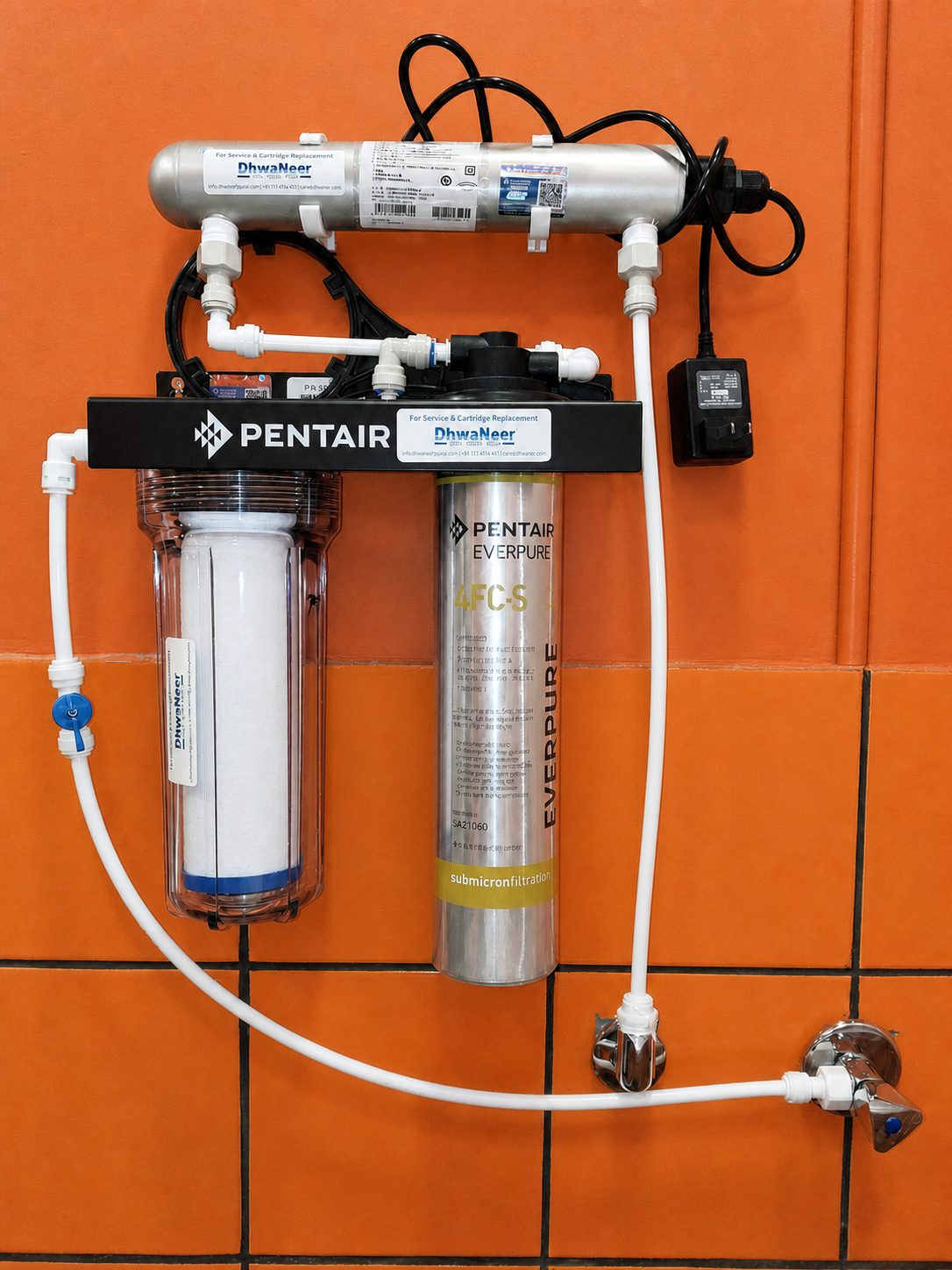
Pentair’s current Everpure foodservice reference guide explicitly separates coffee, espresso, ice, boilerless steam, boiler steam, and warewashing applications and maps products to distinct benefits such as particulate reduction, scale inhibition, scale reduction, TDS reduction, mineral blending, and chlorine taste-and-odour reduction. That application matrix reinforces the need to select by duty rather than brand name alone. [Source: Pentair Everpure Foodservice Product Reference Guide]
When should equipment have separate treatment branches?
Separate branches are usually worth evaluating when:
- the espresso machine needs retained or restored minerals but steam equipment requires broader dissolved-solids reduction;
- the ice maker and coffee machine have different chlorine or conductivity requirements;
- one appliance has a strict chloride limit;
- peak-flow demand would create excessive pressure loss through one small cartridge;
- one machine needs scale inhibition while another needs actual hardness reduction;
- different cartridge capacities would create inefficient replacement schedules;
- one critical machine needs isolation or redundancy; or
- the manufacturer requires a dedicated treatment device or connection.
A common arrangement may use shared upstream sediment treatment followed by application-specific coffee, ice, and steam branches. This is only an example; the actual arrangement must follow the source report and equipment specifications.
How to size a commercial filtration system
1. Determine peak flow—not just daily litres
List the required flow and pressure for every appliance. Identify which machines can draw water simultaneously. The system and pipework must supply that instantaneous condition at an acceptable pressure.
Adding cartridge capacity without checking flow is a common error. A high-capacity cartridge can still have an insufficient service flow or excessive pressure drop for the connected load.
2. Estimate daily and monthly throughput
Use metered consumption where possible. Otherwise build demand from manufacturer water-use data and verified operating cycles.
Apply an explicit, justified design allowance rather than a hidden “safety factor.” Do not count water that never passes through the treatment branch.
3. Read capacity against the correct claim
A cartridge can have different performance endpoints for particulate, chlorine, chloramine, scale control, or another claim. Confirm which rated capacity governs under the actual inlet concentration and flow.
Do not assume the largest number on a datasheet applies to every reduction function.
4. Check pressure loss throughout cartridge life
Consider:
- inlet static and dynamic pressure;
- clean-system pressure drop at design flow;
- loading by sediment;
- manifold, valve, hose, elevation, and pipe losses;
- minimum appliance inlet pressure; and
- simultaneous demand.
Install pressure measurement where it helps operators identify loading and supply problems.
5. Plan cartridge replacement and sanitisation
Use the manufacturer’s stated capacity, pressure-drop endpoint, maximum service interval, and hygiene procedure. Replacement may be triggered by throughput, time, pressure loss, water-quality breakthrough, or the earliest applicable limit.
Pentair’s Claris guidance, for example, says to replace the relevant cartridge when its pre-calculated volume is reached or at least annually and to flush at installation and changeout. That instruction applies to that product family, not every cartridge. [Source: Pentair Everpure Claris Gen2 specification]
What to test before design
The required test panel depends on the source and equipment, but a commercial coffee, ice, and steam review commonly considers:
- microbiological indicators for potable applications;
- turbidity and suspended solids;
- pH;
- conductivity and laboratory TDS;
- total hardness, calcium, and magnesium;
- total alkalinity;
- chloride and sulphate;
- silica for relevant steam or membrane duties;
- iron and manganese;
- free and total chlorine or chloramine, as applicable;
- nitrate, fluoride, and other health-related parameters required for the source; and
- temperature, pressure, and flow measured at the site.
Test every real source. A restaurant may receive municipal, borewell, tanker, or blended water at different times. The label “tanker water” is not a chemical analysis.
CGWB’s 2025 groundwater-quality report shows strong geographic variation and seasonal changes in some measured groundwater parameters. This supports source- and season-aware sampling, but it does not justify assuming a specific hardness or TDS trend at an individual kitchen without measurement. [Source: CGWB Annual Ground Water Quality Report 2025]
If you are not sure how to read the laboratory figures once they arrive, see how to read a commercial water-test report.
A practical system-design workflow
Step 1: Make an appliance schedule
Record manufacturer, model, serial number, application, inlet size, required flow, pressure, water temperature, daily use, cleaning demand, current treatment, and criticality.
Step 2: Create an OEM water-quality matrix
Transcribe every parameter from the current installation manual. Do not combine “not stated” with “unlimited.” Ask the manufacturer where a parameter is missing but operationally important.
Step 3: Sample the source and point of use
Use representative laboratory sampling and site measurements. If a central plant already exists, test before and after it and at the furthest appliance.
Step 4: Define each treatment gap
For every appliance, compare incoming and required water. Identify what must be removed, reduced, retained, or restored.
Step 5: Decide shared versus dedicated branches
Group only compatible water profiles. Check simultaneous flow, pressure, maintenance isolation, stagnation, and monitoring.
Step 6: Select documented products
Verify product-specific claims, materials, certifications where applicable, rated service flow, capacity, pressure, temperature, bypass or blending range, flushing, and replacement instructions.
Step 7: Commission with evidence
Record raw and treated water quality, pressure under demand, flow, bypass setting, cartridge identity, installation date, meter reading, flushing, sanitation, and appliance inlet results.
Step 8: Operate through a service log
Track throughput, pressure drop, test results, alarms, cleaning, sanitisation, cartridge changes, softener regeneration, RO performance, source changes, and service observations.
Hypothetical example: why one cartridge may not suit all three
Consider a hypothetical café-kitchen with potable incoming water at:
- total hardness: 230 mg/L as CaCO3;
- alkalinity: 190 mg/L as CaCO3;
- TDS: 480 mg/L;
- chloride: 65 mg/L; and
- free chlorine: 0.4 mg/L.
These values are invented for explanation and are not a DhwaNeer project.
The espresso machine may need lower hardness, alkalinity, TDS, chloride, and chlorine than the incoming supply. An ice maker may need particulate and scale management while retaining at least its specified minimum conductivity. A particular combi oven may have its own chlorine, chloride, hardness, and conductivity instructions.
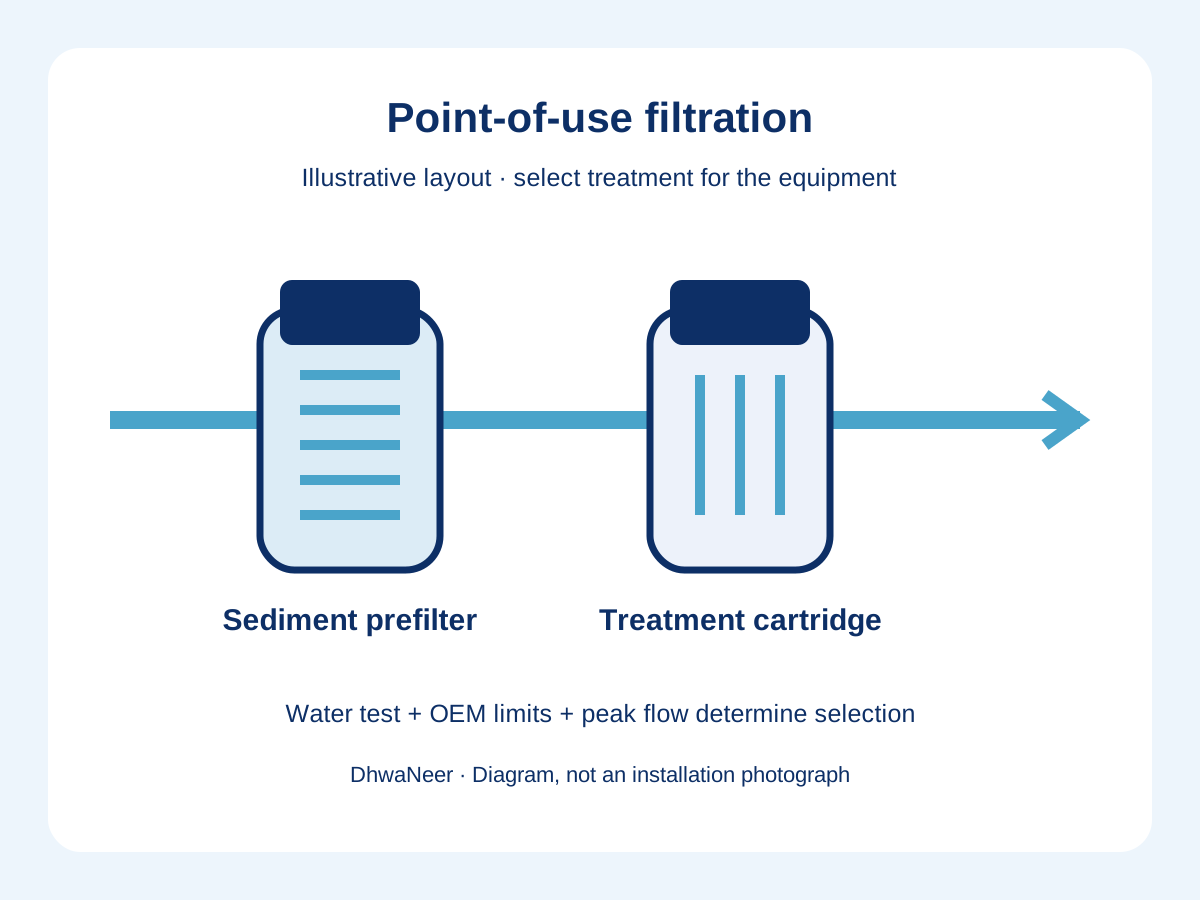
A shared sediment prefilter could be useful. But a single carbon cartridge would not by itself establish the espresso mineral profile, and direct RO permeate might fall below an appliance’s minimum conductivity or desired coffee profile. The likely engineering task is to create compatible branches, not to search for a universal cartridge.
The final selection still requires the complete laboratory report, exact OEM manuals, peak flows, temperature, pressure, drainage, hygiene plan, and validated product data.
Common filtration mistakes
- Buying by micron rating alone. Micron size does not define hardness, chlorine, TDS, or microbial performance.
- Assuming every NSF mark means the same thing. Verify the exact standard and contaminant-reduction claim.
- Using a TDS meter as a complete water test. It cannot identify hardness, alkalinity, chloride, silica, or microbiological safety.
- Putting coffee, ice, and steam on one cartridge by default. Their required profiles may conflict.
- Ignoring peak flow and dynamic pressure. Average daily litres do not prevent pressure starvation during simultaneous draw.
- Treating cartridge capacity as universal. Capacity is tied to the relevant claim and test conditions.
- Removing all minerals without checking minimum conductivity. Some sensors and machines require mineral content.
- Reducing chlorine without downstream hygiene controls. Filtered pipework and equipment still require flushing, cleaning, and sanitisation.
- Changing filters only when taste changes. Scale, pressure loss, or claim capacity can be exhausted before an obvious taste signal.
- Blaming water treatment for heat-related ice loss. Ambient temperature, inlet-water temperature, ventilation, and condenser condition need separate diagnosis.
- Ignoring alternate sources. Municipal, tanker, and borewell water can require different treatment.
- Installing a bypass and leaving it unsealed or unlogged. An undocumented setting change can alter every downstream result.
For the wider equipment picture behind several of these points, see how hard water affects commercial-kitchen equipment and the comparison of a water softener and an RO plant.
Frequently asked questions
Can one water filter serve coffee, ice, and a combi oven?
Yes, but only when all three accept the same treated-water profile and the system meets their combined peak flow, pressure, capacity, hygiene, and service requirements. Separate branches are often necessary.
Does activated carbon remove hardness?
Standard activated carbon is not a hardness-removal process. It may reduce specified chlorine, taste, odour, or organic compounds according to the product claim. Hardness requires a supported hardness-reduction or scale-management process.
Is RO water suitable for espresso?
RO may be part of the solution when incoming dissolved constituents need broad reduction. Direct permeate may be too low in minerals or alkalinity for a particular machine or beverage profile, so controlled blending or remineralisation may be needed.
Should an ice machine use RO water?
Only when the source-water problem and machine specification justify it. Verify potability, minimum conductivity, pH, pressure, flow, product-water hygiene, concentrate handling, and the current OEM instructions.
Does a combi oven always need a water softener?
No. The current RATIONAL manual cited above states that upstream softening is not necessary for its covered iCombi models when used according to instructions. Other manufacturers and models may differ. Follow the exact manual.
How often should commercial filter cartridges be changed?
Use the earliest applicable manufacturer endpoint: rated throughput, time limit, excessive pressure drop, verified breakthrough, or another stated condition. There is no universal replacement interval.
Does filtration make unsafe water potable?
Not automatically. Potability requires the full applicable chemical and microbiological quality. Use only treatment with validated performance for the identified hazard, followed by hygienic storage and distribution.
What should be monitored after installation?
Monitor the parameters the treatment is intended to control, plus flow, dynamic pressure, throughput, bypass or blend setting, cartridge status, cleaning, sanitisation, source changes, and appliance service observations.
Specify water by application, then select the system
The reliable sequence is:
- establish potable-water compliance;
- test the actual source or sources;
- collect current specifications for every machine;
- define each application’s water-quality gap;
- decide which pretreatment can be shared;
- create dedicated branches where profiles conflict;
- size for peak flow, capacity, pressure, and temperature;
- commission with measured results; and
- maintain water-quality, throughput, and hygiene records.
DhwaNeer designs and executes commercial filtration, softening, RO, pumping, disinfection, and turnkey water-treatment systems for restaurants, cafés, hotels, commercial kitchens, corporate facilities, institutions, and utilities. DhwaNeer’s application-specific foodservice work can include appropriate Pentair Everpure integration where the selected product’s documented function matches the verified requirement.
Sources and verification notes
This article was fact-checked on 18 July 2026 using Indian government and food-safety documents, international certification and treatment references, and original equipment-manufacturer manuals. Every numerical appliance value is tied to the cited manufacturer document and must not be applied to another model without confirmation.
- Government of India: Uniform Drinking Water Quality Monitoring Protocol
- Bureau of Indian Standards: IS 10500 Drinking Water Specification
- FSSAI: Food Service Establishment Hygiene Rating Checklist
- Central Ground Water Board: Annual Ground Water Quality Report 2025
- NSF: NSF/ANSI 42, 53 and 401 filtration-system standards
- La Marzocco: Water specifications
- Hoshizaki: Purified-water service bulletin
- Hoshizaki: Training and cleaning guidance
- Scotsman: HID207 service manual
- Scotsman: FS2330 service manual
- RATIONAL: iCombi Pro/iCombi Classic installation manual
- Pentair Everpure: Foodservice Product Reference Guide
- Pentair Everpure: Claris Gen2 specification
- US Geological Survey: Hardness of Water
- US EPA: Overview of Drinking Water Treatment Technologies
- Hoshizaki: AM-50 service manual