On this page
- Why hotel water systems are unusually complex
- Map the hotel before selecting treatment
- Establish the Indian compliance baseline
- Do not size a hotel plant from room count alone
- Define a water-quality target for every circuit
- Treatment processes—and what each one does not solve
- When does a hotel need a softener, RO, both or neither?
- Storage and pumping are part of water quality
- Hotel water safety requires more than an outlet test
- Plan for variable Indian water sources
- Wastewater treatment and reuse need a separate quality plan
- Redundancy should follow operational consequence
- A practical hotel water-treatment design workflow
- Hypothetical planning example
- Common hotel water-treatment mistakes
- Frequently asked questions
- Plan the whole water path—not only the plant room
- Sources and verification notes
A hotel does not need one water quality. It needs several defined water qualities delivered reliably to the right places.
Guest rooms require safe, acceptable hot and cold water at usable pressure. Restaurants, banquets, ice makers and beverage equipment need potable water plus application-specific protection. Laundry may need hardness control. Boilers and cooling towers need engineered water chemistry. Pools, spas, irrigation and toilet flushing have separate operating and regulatory requirements.
Treating every litre with one oversized RO plant can waste water and energy while still leaving storage, pressure, hygiene, scale or corrosion problems unresolved. Installing only a softener can be equally incomplete when the source has microbial, particulate, salinity, iron, fluoride, nitrate or other concerns.
Design a hotel water-treatment system by circuit. First verify every source, quantify demand and peak flow by use, and define the required quality at each endpoint. Then combine compatible circuits and separate conflicting ones. Include raw and treated storage, pumping, treatment residuals, monitoring, distribution hygiene, maintenance access, source changes and downtime in the design—not only the treatment equipment.
Why hotel water systems are unusually complex
Hotels combine residential, foodservice, commercial laundry, recreational and mechanical-building water uses in one property. Demand changes by time of day, occupancy, banquets, housekeeping schedules, laundry operation, weather and cooling load.
The consequences of poor planning can appear in different departments:
- guest complaints about odour, colour, taste, pressure or visible scale;
- recurring heater, showerhead or sanitary-fitting deposits;
- kitchen or beverage equipment outside its manufacturer water specification;
- laundry spotting, poor detergent performance or scale;
- microbiological risk in tanks, remote pipework, showers, spas or low-use rooms;
- cooling-tower or boiler scaling, corrosion, fouling or excessive blowdown;
- RO concentrate and softener-regeneration flows that the drain system was not designed to receive; and
- treatment shutdowns that interrupt occupied rooms or foodservice.
No single result—such as TDS, hardness or a clear-looking sample—can describe all these risks.
Map the hotel before selecting treatment
A useful first design deliverable is a water-use and water-quality map.
| Hotel circuit | Typical uses | Primary design questions |
|---|---|---|
| Incoming sources | Municipal, borewell, tanker, approved alternate supply or blends | Is each source legally usable, reliable and fully tested? How and when do sources change? |
| Raw-water storage | Buffering intermittent supply before treatment | What is the supply schedule, turnover, cleaning access and contamination control? |
| Potable cold water | Guest-room basins, kitchen, drinking points and other approved uses | Does it meet applicable potable-water requirements at source and endpoints? |
| Domestic hot water | Guest showers, basins, kitchens and housekeeping | How are scale, corrosion, temperature, circulation, stagnation and microbial risk managed? |
| Kitchen and banquet | Cooking, food contact, warewashing, coffee, ice and steam equipment | Which uses require common potable water, softened water or application-specific filtration? |
| Laundry | Washing, rinsing, finishing and equipment feed | What do the washer, chemical supplier, fabric programme and source chemistry require? |
| Boiler and steam | Heating, process steam or laundry utility | What feed and boiler-water chemistry does the manufacturer and qualified operator specify? |
| Cooling tower and HVAC | Condenser-water makeup and blowdown | What cycles, scale, corrosion, fouling and microbiological controls are required? |
| Pool and spa | Recreational water | Which separate health, disinfection, filtration and operating rules apply? |
| Reclaimed-water network | Approved toilet flushing, landscaping, cooling or other permitted non-potable use | Is treatment fit for the end use, with dual plumbing, identification and cross-connection control? |
| Fire-water reserve | Fire protection | What do the applicable fire authority and building design require, and how is the reserve protected from unauthorised use? |
This map prevents a common mistake: sending incompatible applications through one treatment line simply because they are in the same building.
Establish the Indian compliance baseline
Potable water
Government of India material reproducing IS 10500 lists important drinking-water values including:
| Parameter | Acceptable limit | Permissible limit in the absence of an alternate source |
|---|---|---|
| TDS | 500 mg/L | 2,000 mg/L |
| Total hardness as CaCO3 | 200 mg/L | 600 mg/L |
| Turbidity | 1 NTU | 5 NTU |
| pH | 6.5-8.5 | 6.5-8.5 |
| Chloride | 250 mg/L | 1,000 mg/L |
| Iron | 0.3 mg/L | 0.3 mg/L |
| Nitrate | 45 mg/L | 45 mg/L |
| E. coli or thermotolerant coliforms | Nil per 100 mL | Nil per 100 mL |
Source: Government of India, Uniform Drinking Water Quality Monitoring Protocol
The complete applicable specification and local requirements must be used; this table is not the full standard. The permissible limit is also not automatically the right target for equipment or guest experience.
Food and beverage water
FSSAI's foodservice hygiene framework calls for potable water meeting IS 10500 where water is used as an ingredient or contacts food or food-contact surfaces, subject to the checklist's specified testing and municipal-supply provisions. This applies to hotel kitchens, banquets, beverage preparation and ice where relevant. [Source: FSSAI Food Service Establishment Hygiene Rating Checklist]
Potability does not prove that water meets a coffee machine, ice maker, dishwasher or combi-oven specification. Appliance protection is an additional requirement.
Building demand and plumbing
IS 1172 covers basic water-supply, drainage and sanitation requirements for residential, commercial and other urban buildings. Project teams should use the current applicable standard, National Building Code provisions, state and municipal by-laws, fire requirements and approvals rather than copying a generic internet figure. [Source: BIS preview and scope of IS 1172]
MoHUA and CPHEEO's 2024 Manual on Water Supply and Treatment Systems (Drink from Tap), Part C further supports management, monitoring and water-safety planning for drinking-water systems. [Source: MoHUA/CPHEEO Part C manual]
Do not size a hotel plant from room count alone
“Litres per room per day” can be a useful early benchmark only when its scope and source are defined. It is not a final treatment-design method.
Two hotels with the same key count can have very different demand because of:
- single or double occupancy;
- number and type of restaurants and bars;
- banquet capacity and event schedule;
- in-house versus outsourced laundry;
- spa, pool, gym and salon facilities;
- cooling-tower and boiler loads;
- staff facilities and kitchens;
- landscaping and irrigation;
- fixture types and water pressure;
- housekeeping procedures;
- occupancy profile and seasonality; and
- leaks, overflow and operating practices.
Calculate daily demand by end use
Build the estimate circuit by circuit:
Each component should come from applicable code, manufacturer data, measured operating data, a documented fixture or cycle calculation, or an explicitly stated engineering assumption.
Submetering existing properties provides a stronger basis than one total utility bill. At a minimum, consider source inlet, treated potable water, hot-water makeup, kitchen, laundry, cooling tower, irrigation and reclaimed water where present.
Size peak flow separately
Daily volume sizes production and storage; it does not establish instantaneous flow.
Peak flow must consider fixture diversity, simultaneous guest demand, kitchen service, laundry fill, banquet events, backwash, softener regeneration, tank filling and pressure-zone operation. Use the applicable plumbing method and actual equipment requirements.
A plant that produces enough litres per day can still fail if filters, softeners, pumps or pipes cannot pass the morning peak at the required pressure.
Determine effective operating hours
Do not divide daily demand by 24 unless the treatment plant can genuinely operate and recover across all 24 hours. Deduct backwash, regeneration, membrane cleaning, sanitisation, maintenance, low-source periods and other downtime.
For RO:
The result must then be checked against membrane output at the design feed temperature, recovery, storage, peak draw, redundancy and concentrate handling.
Define a water-quality target for every circuit
1. Guest-room cold water
The target begins with applicable potable-water compliance. It also includes colour, odour, taste, temperature, pressure, tank turnover and distribution hygiene.
If the source is already compliant municipal water, treatment may focus on verified site-specific issues and safe storage rather than automatically adding RO. If borewell or tanker water is used, a complete chemical and microbiological assessment is required; a TDS reading alone is inadequate.
2. Guest-room hot water
Hot-water systems need coordinated scale, corrosion, energy, temperature, circulation and microbiological management.
USGS notes that heating hard water can form calcium-carbonate scale and that deposits can clog pipes and reduce water-heater efficiency. It also notes that excessively soft or aggressive water can create corrosion concerns. [Sources: USGS scale explanation] and [USGS groundwater-quality overview]
This means “zero hardness everywhere” is not a universal target. The correct profile depends on complete chemistry, metallurgy, temperature, heater requirements and corrosion-control strategy.
3. Kitchens, coffee, ice and steam equipment
Hotel foodservice can require several branches:
- potable water for food and beverage contact;
- softened water for approved warewashing or hot-water duties;
- controlled-mineral water for coffee equipment;
- application-specific filtration for ice;
- model-specific conditioned water for combi ovens and steamers; and
- RO water only where the source and endpoint requirement justify it.
Pentair Everpure's foodservice guide separates coffee, espresso, ice, boilerless steam, boiler steam and warewashing and maps products to different functions. That manufacturer structure reinforces the need for application selection rather than a generic “kitchen filter.” [Source: Pentair Everpure Foodservice Product Reference Guide]
See DhwaNeer's dedicated guide: Water filtration for coffee, ice and steam equipment.
4. Laundry
Laundry water affects detergent interaction, rinsing, heating surfaces and final appearance. USGS identifies calcium and magnesium as the principal causes of hardness and notes that hard water reduces soap and detergent performance. [Source: USGS, Hardness of Water]
Potential treatment may include particulate or iron control, softening, or another process, but the target must be agreed with:
- the washer manufacturer;
- laundry chemical supplier;
- fabric and linen programme;
- heater or steam system;
- incoming water analysis; and
- required peak fill flow.
Do not assume that laundry requires RO. Do not size a softener only from average daily volume; use hardness load, peak flow, resin capacity, regeneration, salt storage, drainage and continuity.
5. Boilers and steam systems
Boiler feed is a specialist application. Required makeup quality depends on boiler type, pressure, steam use, condensate return, blowdown, metallurgy and manufacturer limits.
Possible processes include softening, RO or demineralisation, deaeration, chemical dosing, condensate management and controlled blowdown. The presence of a softener does not establish correct boiler-water chemistry.
Use the boiler manufacturer, water-treatment specialist and qualified operator to set feed-water and internal-water limits. Never transfer an espresso, guest-room or cooling-water target to a boiler circuit.
6. Cooling towers
Cooling towers evaporate water and thereby concentrate dissolved minerals in the recirculating water. Blowdown limits that concentration. Scale, corrosion, fouling and microbiological control must be managed together.
The US Department of Energy defines cycles of concentration through the relationship between makeup and blowdown and explains that dissolved-mineral concentration affects scale and corrosion risk. [Sources: DOE cooling-water efficiency guidance] and [DOE cooling-tower components guidance]
Do not maximise cycles or add RO solely from a water-saving claim. Evaluate makeup chemistry, tower metallurgy, heat load, treatment programme, blowdown limits, drift, local discharge rules and microbial control.
Cooling towers are also aerosol-generating systems and belong in the hotel's building-water risk management programme.
7. Pools, spas and decorative water
These systems require their own circulation, filtration, disinfectant, chemistry, testing and operating controls. They should not be treated as extensions of the guest-room potable network.
CDC identifies hot tubs, cooling towers, showers and decorative fountains as relevant hotel water-management locations for Legionella risk. [Source: CDC guidance for hotel owners and managers]
Use applicable Indian state, municipal, health and pollution-control requirements plus equipment-manufacturer instructions.
Treatment processes—and what each one does not solve
| Process | Typical hotel role | Does not automatically provide |
|---|---|---|
| Strainer or sediment filtration | Protect downstream equipment from defined particle sizes | Hardness, TDS or microbiological control |
| Activated carbon | Supported chlorine, taste, odour or organic-reduction duty | Hardness or universal contaminant removal |
| Media filtration | Turbidity, iron or another defined media duty when correctly designed | Potability without validated complete treatment |
| Ion-exchange softening | Calcium- and magnesium-related hardness reduction | TDS reduction, disinfection or removal of every ion |
| RO | Broad dissolved-constituent reduction for a defined product-water circuit | Zero concentrate, zero pretreatment or hygienic storage |
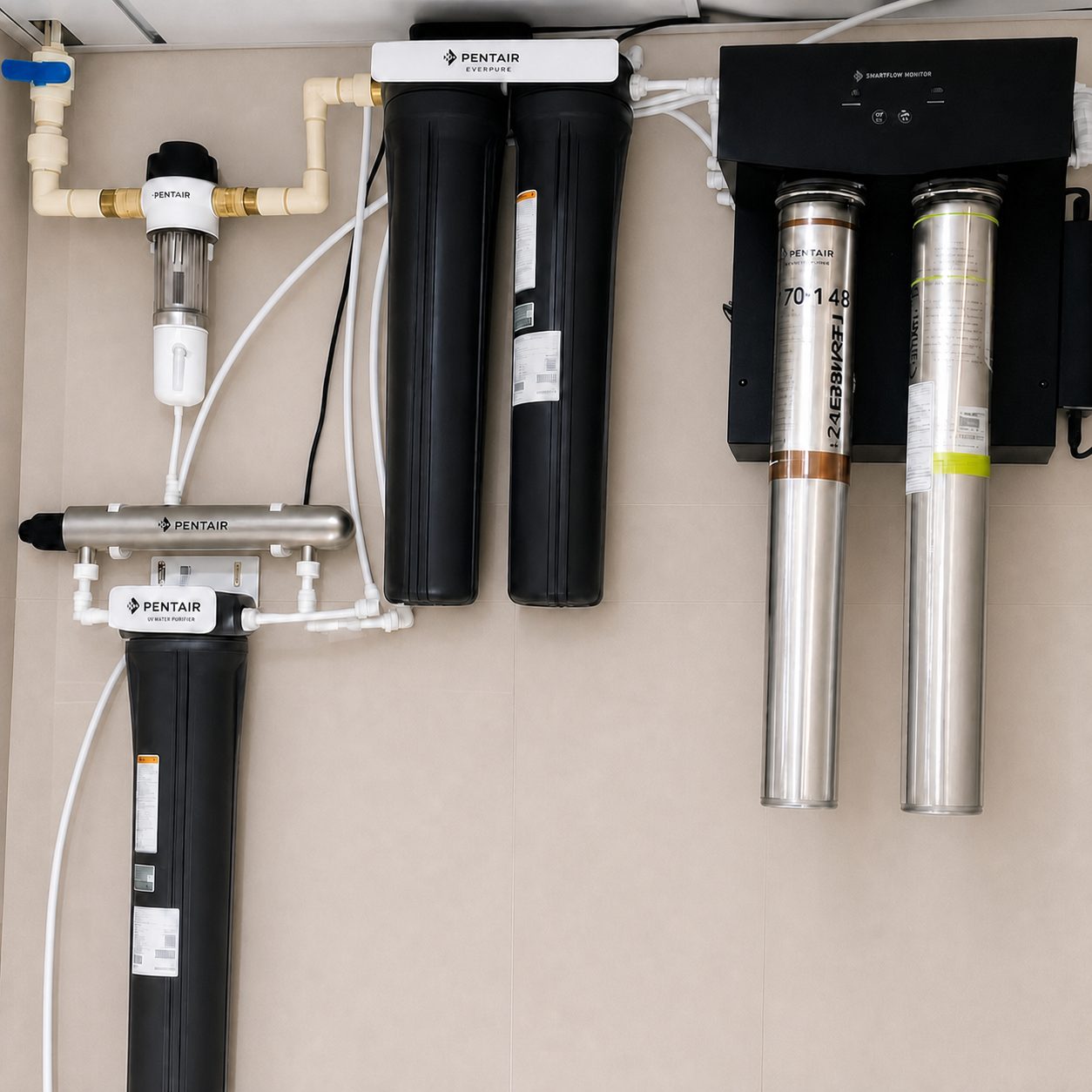
| UV disinfection | Validated inactivation at the specified dose and water quality | A downstream disinfectant residual |
| Chemical disinfection | Microbial control where correctly selected, dosed and monitored | Hardness, TDS or freedom from disinfection by-products |
| Blending or remineralisation | Adjustment of RO product to an approved mineral profile | Safety unless every blend stream is compliant and controlled |
| Hydro-pneumatic pumping | Pressure and flow delivery across demand changes | Water-quality treatment |
WHO guidance notes that UV has no residual disinfection effect and that water clarity and system maintenance matter. [Source: WHO drinking-water guidance on ultraviolet disinfection]
The US EPA notes that RO creates permeate and concentrate, commonly requires pretreatment and may require post-treatment corrosion control. [Source: US EPA drinking-water treatment technologies]
When does a hotel need a softener, RO, both or neither?
Evaluate a softener when
- verified hardness is outside the agreed endpoint requirement;
- hot-water, laundry, warewashing or other equipment needs softened water;
- scale-control demand is high and peak flow suits ion exchange; or
- softening is justified as pretreatment for another process.
A softener exchanges hardness ions and creates regeneration brine and rinse water. EPA notes that cation-exchange softeners use salt and water during regeneration. [Source: US EPA cation-exchange softeners]
Evaluate RO when
- a potable or process circuit requires broader dissolved-solids or specific-ion reduction;
- the complete feed analysis and membrane projection support sustainable operation;
- there is a defined permeate-quality target; and
- concentrate can be legally and practically managed.
RO for selected drinking, beverage or equipment circuits may be justified without sending all guest-room or utility water through RO.
Evaluate both when
- softened water is used for one hotel circuit while RO serves another;
- a softener is justified as RO pretreatment; or
- central hardness control and point-of-use mineral control are both required.
Evaluate neither when
The verified source already meets the potable, operational and equipment requirements, and additional treatment would not manage a defined risk. Safe storage, disinfection residual, distribution, pressure, monitoring and maintenance may still require work.
Storage and pumping are part of water quality
A treatment plant cannot compensate for contaminated, stagnant or overflowing tanks. A hydro-pneumatic system cannot compensate for an undersized treatment line.
Storage design should consider
- source-supply schedule and interruptions;
- daily and peak demand by water quality;
- effective treatment production hours;
- usable rather than nominal tank volume;
- low-level and overflow controls;
- turnover and stagnation risk;
- cleaning, drainage, access and ventilation details;
- separation of raw, potable, softened, RO and reclaimed water;
- maintenance and emergency operating modes; and
- applicable fire-reserve requirements.
Pumping design should consider
- peak simultaneous flow;
- minimum and maximum pressure at endpoints;
- building height and pressure zones;
- static lift and friction loss;
- filter pressure drop at clean and loaded conditions;
- pump control and minimum-flow behaviour;
- electrical supply and backup strategy;
- duty/standby philosophy based on operational consequence; and
- prevention of cross-connections and negative-pressure events.
High pressure can increase leakage and damage fixtures; low pressure creates service failures. Size from a hydraulic model or documented calculation, not pump motor power alone.
Hotel water safety requires more than an outlet test
Water can meet a source test and deteriorate in building storage or distribution.
WHO's hotel-specific Legionella and the Prevention of Legionellosis guidance recommends a water-safety-plan approach based on system assessment, monitoring and surveillance. CDC similarly advises hotel owners to use a continuous water management programme that identifies where Legionella can grow and spread, manages those risks and triggers action when control is lost. [Sources: WHO hotel water-safety guidance] and [CDC hotel guidance]
Relevant hotel conditions include:
- warm water and heat gain to nominally cold lines;
- low disinfectant residual;
- storage and remote endpoints;
- dead legs and blind ends;
- low-flow fixtures;
- unoccupied floors or rooms;
- shutdown and reopening;
- cooling towers, spas and decorative fountains; and
- construction, repairs or supply interruptions.
India's warm climate can make cold-water heat gain especially relevant, but a control programme must be site-specific. Do not copy a foreign temperature or disinfectant setpoint without checking Indian requirements, system design and qualified public-health guidance.
Treatment commissioning and building-water management are therefore linked but not identical. The treatment contractor, hotel engineering team, public-health adviser, equipment vendors and management must have defined responsibilities.
Plan for variable Indian water sources
Hotels may switch between municipal, borewell and tanker water as availability changes. These sources can differ substantially in hardness, TDS, chloride, iron, turbidity, disinfectant residual and microbiological quality.
CGWB's 2025 national report demonstrates geographic variation and seasonal change in measured groundwater parameters. It supports location- and season-aware testing, but it does not prove that hardness or TDS will move in one direction at every hotel after the monsoon. [Source: CGWB Annual Ground Water Quality Report 2025]
A robust source-management plan includes:
- approved source list;
- source-specific laboratory results;
- tanker receipt and traceability controls where applicable;
- controlled source switching and blending;
- defined operator tests at changeover;
- treatment settings that match the actual source;
- alarms or interlocks for critical conditions; and
- follow-up endpoint verification.
Wastewater treatment and reuse need a separate quality plan
Hotel STP water may reduce freshwater demand where reuse is approved, but “treated” does not mean suitable for every reuse.
MoHUA's decentralised-wastewater guidance states that reuse can include landscaping, irrigation, industrial purposes and toilet flushing depending on treated-water quality. It also calls for assessment of reuse demand, environmental and economic considerations, monitoring and compliance with the concerned regulatory board. [Source: MoHUA Guidelines for Decentralized Wastewater Management]
For hotel reuse:
- define the permitted end use and quality criteria;
- provide treatment and disinfection suited to that end use;
- use clearly identified dual plumbing;
- prevent cross-connection with potable water;
- manage storage, odour, colour and stagnation;
- monitor the required parameters;
- plan a safe response to off-specification water; and
- obtain applicable state, municipal and pollution-control approvals.
RO concentrate, softener brine, filter backwash, cooling-tower blowdown and swimming-pool wastewater are different streams. Do not send them to an STP or reuse system without checking hydraulic load, salinity, chemicals, treatment compatibility and discharge permission.
Redundancy should follow operational consequence
Not every component needs duplication, but every critical failure needs an operating plan.
Ask:
- How long can occupied rooms operate without the plant?
- Can kitchen, laundry or banquets continue during maintenance?
- Is there usable treated-water storage?
- Can one pump, vessel, membrane train or disinfection unit be isolated safely?
- Can a softener regenerate without hard-water breakthrough?
- Are spare cartridges, lamps, membranes, valves and dosing consumables available?
- What happens during a power outage or source interruption?
- Is bypass water safe and suitable for every connected endpoint?
A bypass is not automatically redundancy. If it supplies untreated or off-specification water, it may preserve flow while compromising safety or equipment.
A practical hotel water-treatment design workflow
Step 1: Audit the property
Record keys, occupancy profile, restaurants, banquet capacity, laundry, staff facilities, pools, spa, landscaping, cooling, boiler systems, existing tanks, pumps and treatment.
Step 2: Verify every source
Test complete chemical and microbiological quality through a suitable laboratory. Measure on-site temperature, pressure, source availability and variation.
Step 3: Create the demand model
Calculate daily and peak demand by circuit. Use meters, fixture methods, appliance data, laundry cycles, cooling load and documented assumptions.
Step 4: Build the water-quality matrix
For each endpoint, list the applicable regulatory, potable, OEM, process and guest-experience requirements.
Step 5: Develop the treatment and hydraulic concept
Select shared and separate circuits, storage, pressure zones, pretreatment, softening, RO, filtration, disinfection, blending and waste routes.
Step 6: Size for real operating conditions
Check minimum feed temperature where membranes are used, source pressure, peak flow, filter loading, regeneration, backwash, drainage, electrical load, operating hours, maintenance and redundancy.
Step 7: Define acceptance criteria
State measurable raw- and treated-water quality, flows, pressures, recovery where relevant, alarms, tank controls, sanitisation and endpoint results before procurement.
Step 8: Commission the complete path
Commission from source and tanks through treatment, pumps and distribution to representative endpoints. Verify that valves and bypasses match the approved flow diagram.
Step 9: Handover an operating system
Provide drawings, datasheets, settings, test results, consumables, spare-parts list, cleaning and sanitisation procedures, waste routes, alarm responses, log sheets and staff training.
Hypothetical planning example
Consider a hypothetical 120-key city hotel with municipal and tanker supply, two restaurants, banquet operations, in-house laundry, central hot water and a cooling tower.
The correct first decision is not the capacity of an RO plant. The engineering team should first determine:
- whether both sources meet the applicable potable requirements;
- how source quality changes when tanker water enters the raw tank;
- guest-room and staff daily and peak demand;
- kitchen, coffee, ice, warewashing and steam specifications;
- laundry hardness, iron and peak-fill requirements;
- hot-water scale and distribution-hygiene risks;
- cooling-tower makeup chemistry and control programme;
- which circuits truly require RO or softening;
- storage needed during supply and maintenance interruptions; and
- where softener brine, RO concentrate, backwash and blowdown can go.
The final concept might use central source conditioning, separate potable disinfection, a softened utility branch, application-specific foodservice filtration and a dedicated RO circuit. It might also use a different arrangement. The example is not a prescription or a DhwaNeer project claim.
Common hotel water-treatment mistakes
- Sizing from key count alone. Restaurants, banquets, laundry, cooling and occupancy materially change demand.
- Using TDS as the complete water report. It does not identify microbiological risk, hardness, alkalinity, chloride, iron, silica, nitrate or specific contaminants.
- Sending the whole hotel through RO by default. RO may be unnecessary for high-flow utility circuits and creates concentrate.
- Assuming a softener makes water potable. It targets hardness, not every chemical or microbial hazard.
- Giving every kitchen appliance the same filtered water. Coffee, ice, steam and warewashing requirements can conflict.
- Ignoring dynamic pressure. A plant can meet daily volume yet fail during shower, laundry or banquet peaks.
- Treating storage as passive volume. Tanks need turnover, access, controls, cleaning and hygienic management.
- Using treatment bypass as redundancy. Off-specification bypass water may create safety and equipment risks.
- Ignoring low-occupancy rooms. Stagnant branches and reduced disinfectant can require water-management action.
- Mixing reclaimed and potable networks. Cross-connection control and dual-plumbing identification are essential.
- Omitting waste streams. Brine, concentrate, backwash and blowdown affect drains, STPs and approvals.
- Buying equipment before defining acceptance criteria. Product labels cannot replace a source-to-endpoint design.
Frequently asked questions
What water-treatment system does a hotel need?
It depends on source quality and each use. A hotel may require source filtration, disinfection, softening, RO, application-specific foodservice filtration, pumping, storage and utility-water chemistry—or only some of these.
Does every hotel need an RO plant?
No. RO is justified when a defined circuit requires broader dissolved-solids or specific-ion reduction that simpler treatment cannot provide. Compliant source water may not need RO for all uses.
Does a hotel need a water softener?
Evaluate softening when verified hardness conflicts with hot-water, laundry, warewashing, equipment or other requirements. Do not select it from visible scale alone or assume softened water suits every beverage application.
How is a hotel RO plant sized?
Calculate daily RO-product demand only for the circuits that require permeate, divide by effective production hours, and check peak demand, usable storage, feed temperature, recovery, pretreatment, downtime, redundancy and concentrate management.
Can guest rooms use softened water?
They can where the complete treated-water chemistry, potability, materials, operating requirements and local rules support it. Softening alone does not prove water safety, and sodium or corrosion considerations may require review.
Should laundry and guest rooms share one softener?
Only if both need the same outlet hardness and the softener can meet combined peak flow, hardness load, regeneration and continuity requirements. Separate circuits may be operationally better.
Can STP-treated water be reused in a hotel?
Potentially, for approved non-potable uses when the treatment meets end-use quality and regulatory requirements. Dual plumbing, cross-connection prevention, monitoring and an off-specification response are required.
How often should hotel water be tested?
Follow applicable regulations, FSSAI requirements, local authority conditions, source risk, water-safety plan and equipment needs. Increase verification after source changes, treatment work, contamination events, long shutdowns or abnormal results. There is no single interval for every parameter and endpoint.
What should be included in hotel water-treatment commissioning?
Verify source and treated quality, flows, dynamic pressures, tank controls, treatment settings, disinfection, bypass positions, alarms, waste flows and representative endpoints. Handover records and operator training are part of commissioning.
Plan the whole water path—not only the plant room
A dependable hotel water system follows this sequence:
- verify every source;
- map every use and risk;
- calculate daily demand and peak flow by circuit;
- define endpoint water quality;
- separate incompatible applications;
- size treatment, tanks and pumps together;
- plan brine, concentrate, backwash, blowdown and reuse;
- commission from source to endpoint; and
- operate through monitoring, water-safety and maintenance programmes.
DhwaNeer designs and executes commercial filtration, softening, RO, pumping, disinfection and turnkey water-treatment systems for hotels, restaurants, commercial kitchens, corporate facilities, institutions and utilities.
Sources and verification notes
This article was fact-checked on 18 July 2026 using Indian government, standards, public-health, scientific and original manufacturer sources.
Hotel management should obtain specialist public-health advice for its building-water and Legionella programme, qualified boiler and cooling-water advice for utility systems, and applicable regulatory approvals for potable supply, groundwater abstraction, wastewater treatment, reuse and discharge.
- Government of India: Uniform Drinking Water Quality Monitoring Protocol
- Bureau of Indian Standards: IS 10500 Drinking Water Specification
- Bureau of Indian Standards: IS 1172 scope and preview
- FSSAI: Food Service Establishment Hygiene Rating Checklist
- MoHUA/CPHEEO: Manual on Water Supply and Treatment Systems, Part C
- MoHUA: Guidelines for Decentralized Wastewater Management
- Central Ground Water Board: Annual Ground Water Quality Report 2025
- WHO: Water Safety Plan Manual, second edition
- WHO: Legionella and the Prevention of Legionellosis
- CDC: Considerations for Hotel Owners and Managers
- US Geological Survey: Hardness of Water
- US Geological Survey: Lime-scale formation in heated hard water
- US Geological Survey: Groundwater-quality overview
- US EPA: Overview of Drinking Water Treatment Technologies
- US EPA: Cation Exchange Water Softeners
- WHO: Drinking-water guidance on ultraviolet disinfection
- US Department of Energy: Cooling-water efficiency guidance
- US Department of Energy: Cooling-tower components and water management
- Pentair Everpure: Foodservice Product Reference Guide