On this page
- Why plan application by application
- Indian food-service requirements for potable water
- Drinking-water parameters at the planning stage
- Why one old water report is not enough
- Step 1: Map every water application
- Step 2: Sample the water correctly
- Step 3: Match the treatment to the problem
- Step 4: Size for peak demand
- Step 5: Design the plant room and distribution
- Step 6: Commission with evidence
- Step 7: Plan maintenance before opening
- Seven common planning mistakes
- A practical pre-project checklist
- Frequently asked questions
- Plan around your water and your kitchen
- Sources
Water in a restaurant is not one single requirement. The water served to guests, used in cooking, frozen into ice, fed to coffee machines and combi ovens, sent through dishwashers, and used for cleaning can each place different demands on a treatment system.
That is why a restaurant water-treatment project should not begin with a product catalogue or a fixed-capacity RO plant. It should begin with three things: a representative water analysis, an application-wise demand assessment, and a survey of the actual site.
This guide explains how restaurant owners, chefs, facility teams, consultants, and project managers can plan a commercial water-treatment system for Indian operating conditions.
A restaurant water-treatment system should be selected only after testing the source water and mapping each application. The treatment may combine sediment filtration, activated carbon, softening, reverse osmosis, UV disinfection, storage, and pressure management—but not every restaurant needs every technology.
Why restaurant water quality must be planned application by application
Restaurant water normally supports four broad functions:
- Direct consumption and food preparation: guest drinking water, beverages, cooking, washing produce, and ice.
- Taste-sensitive equipment: coffee, espresso, tea, fountain beverages, and ice machines.
- Heat-producing equipment: combi ovens, steamers, boilers, hot-water systems, and dishwashers.
- Utility and hygiene use: handwashing, cleaning, warewashing, and other non-ingredient applications.
These functions are connected, but their water-quality requirements are not necessarily identical. Potability is the minimum safety requirement for water used as an ingredient or in contact with food. Equipment manufacturers may specify narrower limits for parameters such as hardness, alkalinity, chloride, or total dissolved solids to protect a particular machine and maintain output quality.
Pentair Everpure's current foodservice reference guide, for example, publishes different recommended water specifications for coffee and espresso, fountain and drinking water, ice, and steam applications. The same guide states that water feeding steamers or warewashers should meet the relevant equipment manufacturer's requirements. These are application recommendations—not replacements for Indian drinking-water or food-safety requirements. [Source: Pentair Everpure Foodservice Product Reference Guide]
What Indian food-service requirements say about potable water
FSSAI states that licensed food businesses must comply with the hygiene and sanitary requirements in Schedule 4 of the Food Safety and Standards (Licensing and Registration of Food Businesses) Regulations, 2011. [Source: FSSAI hygiene requirements]
FSSAI's food-service hygiene checklist requires potable water meeting IS 10500 where water is used as a product ingredient or comes into contact with food or food-contact surfaces. The checklist also calls for water-testing records and contains specific provisions for municipal supplies and water supplied by malls, commercial hubs, markets, or private authorities. Its current note states that food businesses using water as an ingredient should obtain IS 10500 testing, excluding radioactive parameters, at the stated frequency; businesses relying on qualifying municipal potable water may maintain municipal water-bill records, while those receiving water from a mall or other private authority should obtain the authority's test report. Operators should read the current checklist and licence conditions applicable to their establishment rather than relying on a summary. [Source: FSSAI Food Service Establishment Hygiene Rating Checklist]
For practical project planning, keep three records together:
- the incoming-water laboratory report;
- the treated-water laboratory report for relevant potable outlets; and
- the source record or supplier report required for the site's type of water supply.
Compliance should be confirmed with the current FSSAI requirement and the appropriate regulator or qualified food-safety professional. A water-treatment supplier should not present engineering advice as legal certification.
The Indian drinking-water parameters that matter at the planning stage
IS 10500 is the Indian Standard for drinking-water specification. The Government of India's Jal Jeevan Mission monitoring protocol reproduces important IS 10500:2012 limits and distinguishes between an acceptable limit and a permissible limit in the absence of an alternate source.
| Parameter | IS 10500 acceptable limit | Permissible limit in the absence of an alternate source | Why the restaurant project team reviews it |
|---|---|---|---|
| pH | 6.5-8.5 | No relaxation | Influences treatment selection, corrosion, disinfection, and equipment compatibility |
| Turbidity | 1 NTU | 5 NTU | Indicates suspended matter and can interfere with downstream treatment |
| Total dissolved solids | 500 mg/L | 2,000 mg/L | Helps assess dissolved mineral load and whether membrane treatment needs evaluation |
| Total hardness as CaCO3 | 200 mg/L | 600 mg/L | Helps assess scale risk and the possible need for softening or scale control |
| E. coli or thermotolerant coliforms | Nil per 100 mL | Nil per 100 mL | Microbiological safety indicator |
Source: Government of India, Uniform Drinking Water Quality Monitoring Protocol
These values must be interpreted correctly:
- The permissible limit is not an ideal design target for every restaurant application.
- A potable-water result does not automatically mean the water meets a coffee-machine, ice-machine, combi-oven, boiler, or dishwasher manufacturer's warranty specification.
- TDS does not by itself establish microbiological safety.
- Hardness and TDS are related but are not interchangeable measurements.
- A single handheld TDS reading is not a substitute for a laboratory analysis under the applicable standard.
The full laboratory scope should be chosen against IS 10500 and the source-specific risk, not limited to the five planning parameters shown above.
Why one old water report is not enough
Water quality can vary by location, source, storage condition, and season. A municipal connection, borewell, tanker supply, or mixed source can produce a different treatment requirement even when two restaurants have similar seating capacity.
The Central Ground Water Board's Annual Ground Water Quality Report 2025 evaluated pre- and post-monsoon groundwater quality across India. It found that the effect of monsoon recharge was heterogeneous: some locations improved through dilution, while others deteriorated, with local aquifer conditions and contamination loads influencing the result. [Source: Central Ground Water Board, Annual Ground Water Quality Report 2025]
The planning lesson is not that water always becomes better or worse after the monsoon. It is that a result from another city, another borewell, or another season cannot safely be assumed to represent the restaurant's present source.
Consider fresh sampling when:
- the restaurant begins using a new source;
- municipal and tanker water are mixed;
- a borewell's behaviour changes seasonally;
- taste, odour, colour, turbidity, or scaling changes;
- the treatment system is modified;
- a storage tank or distribution line has been repaired or contaminated; or
- monitoring results show an unexplained shift.
These are risk-based engineering triggers in addition to—not substitutes for—the testing frequency required by FSSAI or another applicable authority.
Step 1: Map every water application
Create a simple water-use schedule before selecting equipment.
| Application | Quantity to establish | Quality requirement to verify | Operational concern |
|---|---|---|---|
| Guest drinking and cooking | Litres per day and peak hour | Potable water under applicable Indian requirements | Safety, taste, storage hygiene |
| Coffee, espresso, and tea | Equipment flow and peak servings | Potability plus equipment/beverage specification | Taste, scale, corrosion, warranty |
| Ice machines | Ice production and inlet demand | Potability plus ice-machine specification | Taste, clarity, scale, biofilm control |
| Combi ovens and steamers | Manufacturer inlet flow | Manufacturer's hardness, TDS, alkalinity, chloride and pressure limits | Scale, corrosion, sensor and boiler performance |
| Dishwashing and warewashing | Cycle demand and peak operation | Equipment specification; hardness control where required | Scale, spotting, detergent performance |
| Hot-water system | Peak flow and temperature duty | Equipment and plumbing requirements | Scale and heat-transfer performance |
| Cleaning and handwashing | Peak flow | Potable water where required by food-safety rules | Availability and hygiene |
Do not use guest count alone to size the plant. A restaurant's peak demand depends on its menu, kitchen equipment, service pattern, number of covers, batch preparation, ice production, operating hours, and storage strategy.
Step 2: Sample the water correctly
A laboratory result is only useful if the sample represents the water that the system will actually treat.
The project team should record:
- source type: municipal, borewell, tanker, harvested water, or a mixture;
- sampling point and date;
- whether the sample is raw or already treated;
- recent source switching or tank cleaning;
- visible colour, sediment, odour, or intermittent supply; and
- whether the source changes during the year.
Use a competent laboratory and request the parameters required by the applicable Indian standard and the site's risk profile. Where microbiological analysis is required, follow the laboratory's sterile bottle, preservation, transport, and holding-time instructions. Improvised sampling can invalidate the result.
Step 3: Match the treatment process to the verified problem
There is no universal restaurant treatment train. Each stage has a different function.
Sediment or media filtration
Physical and media filtration can reduce suspended particles and turbidity, depending on filter design and particle size. It is often used to protect downstream valves, carbon, softener resin, membranes, and UV equipment. Filter selection requires the measured turbidity, particle load, peak flow, pressure loss, and backwash or cartridge-service plan.
Activated carbon
Granular activated carbon is an adsorption medium commonly used for taste- and odour-producing compounds, natural organic matter, and various organic contaminants. Its performance depends on the carbon, contaminant, contact time, flow, and exhaustion point. Carbon is not a universal substitute for softening, disinfection, or RO. [Source: US EPA overview of drinking-water treatment technologies]
Water softening
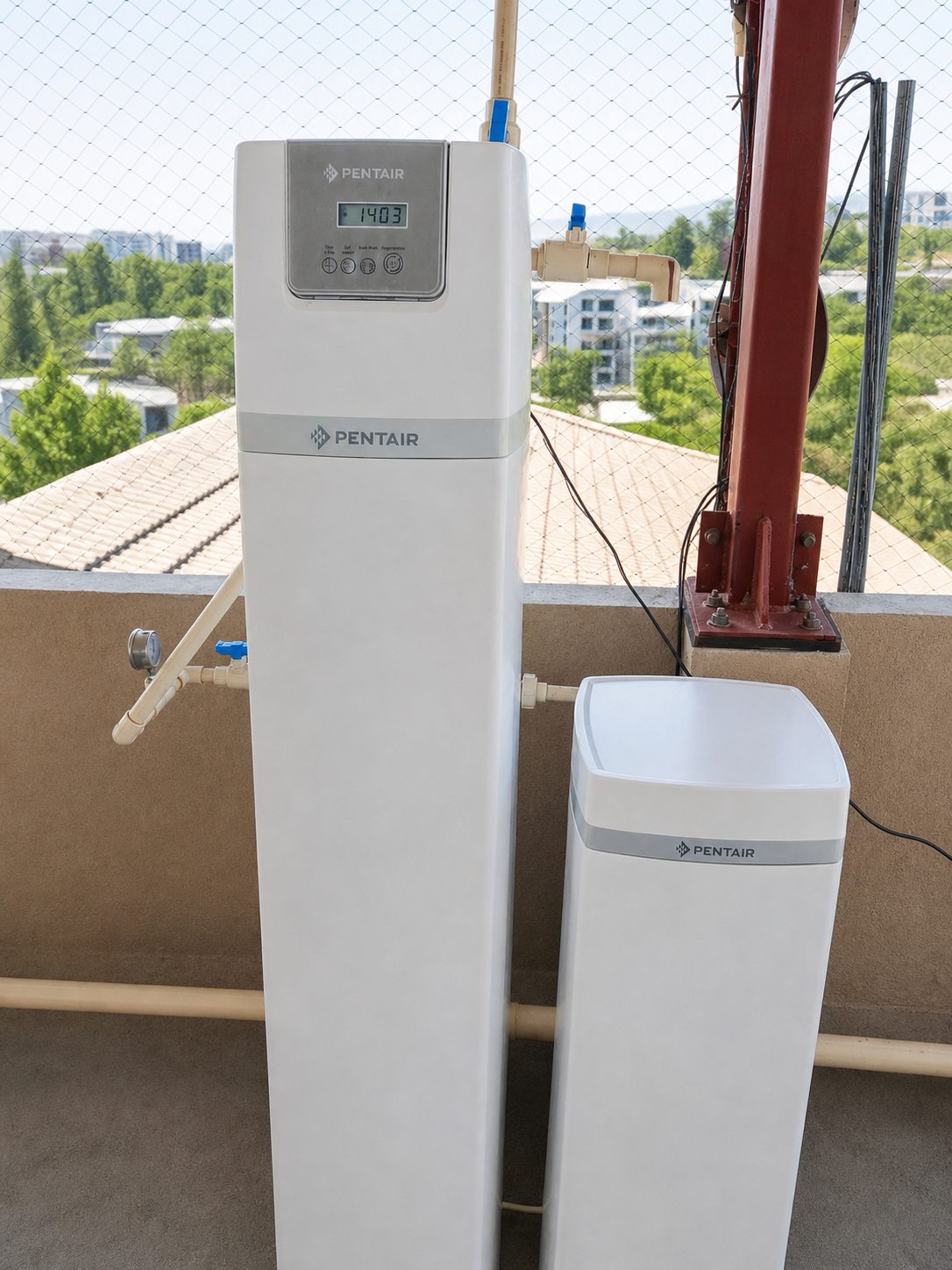
A conventional ion-exchange softener reduces hardness caused by calcium and magnesium ions by exchanging them for sodium or potassium ions. It is selected when verified hardness and the application justify it. It does not, by itself, make microbiologically unsafe water potable or remove every dissolved contaminant. [Source: NSF explanation of water-treatment standards and softening]
Reverse osmosis
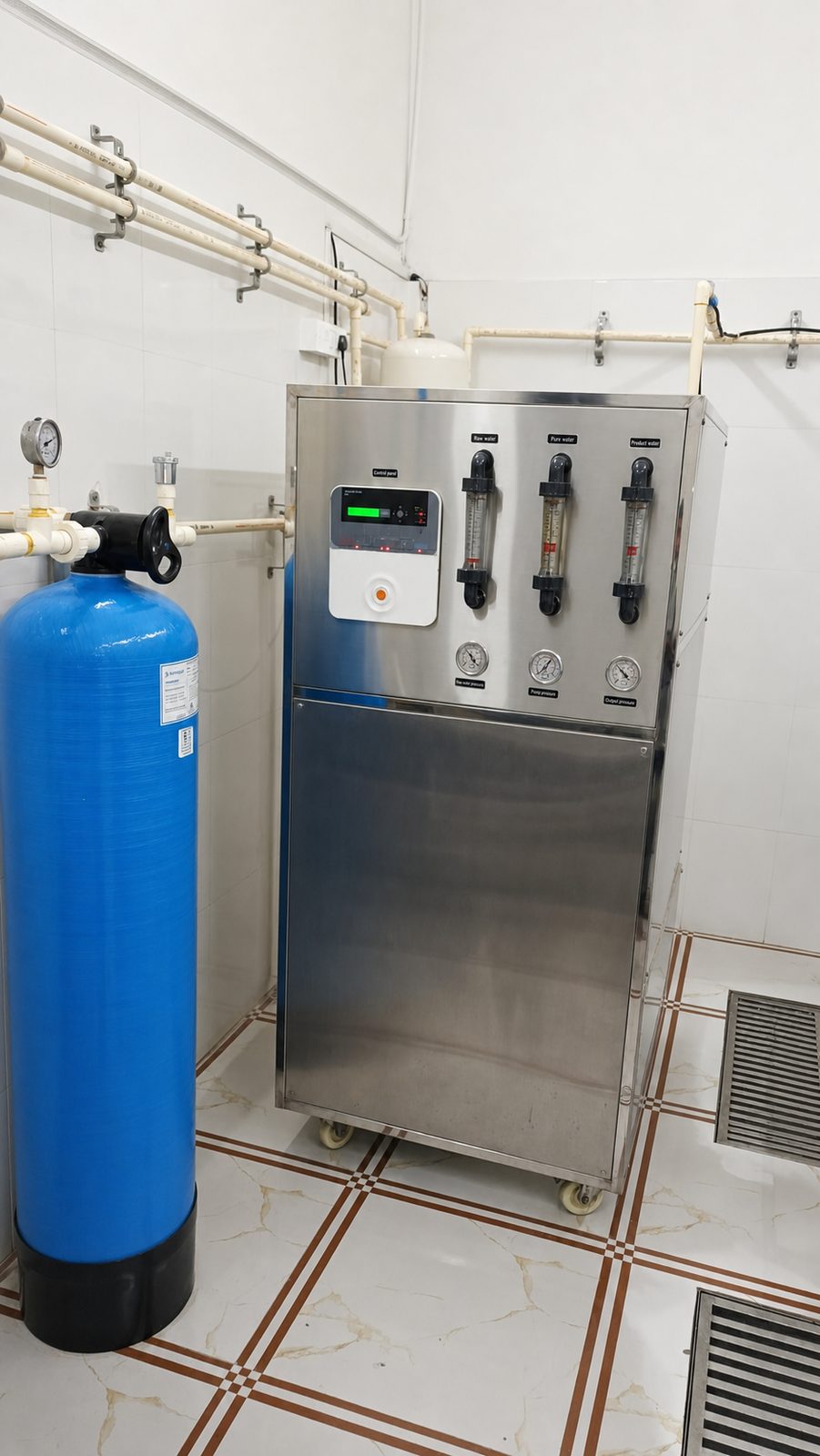
RO uses pressure and a semi-permeable membrane to separate a treated-water stream from a concentrate or reject stream. It can reduce a broad range of dissolved solids and inorganic contaminants, but it is not automatically required for every restaurant.
RO design must consider pretreatment, feed-water quality, membrane selection, recovery, product-water requirement, storage, reject disposal or suitable reuse, and post-treatment. The US EPA notes that RO commonly requires pretreatment to reduce fouling or plugging and produces a concentrate stream that must be managed. [Source: US EPA overview of RO and nanofiltration]
UV disinfection
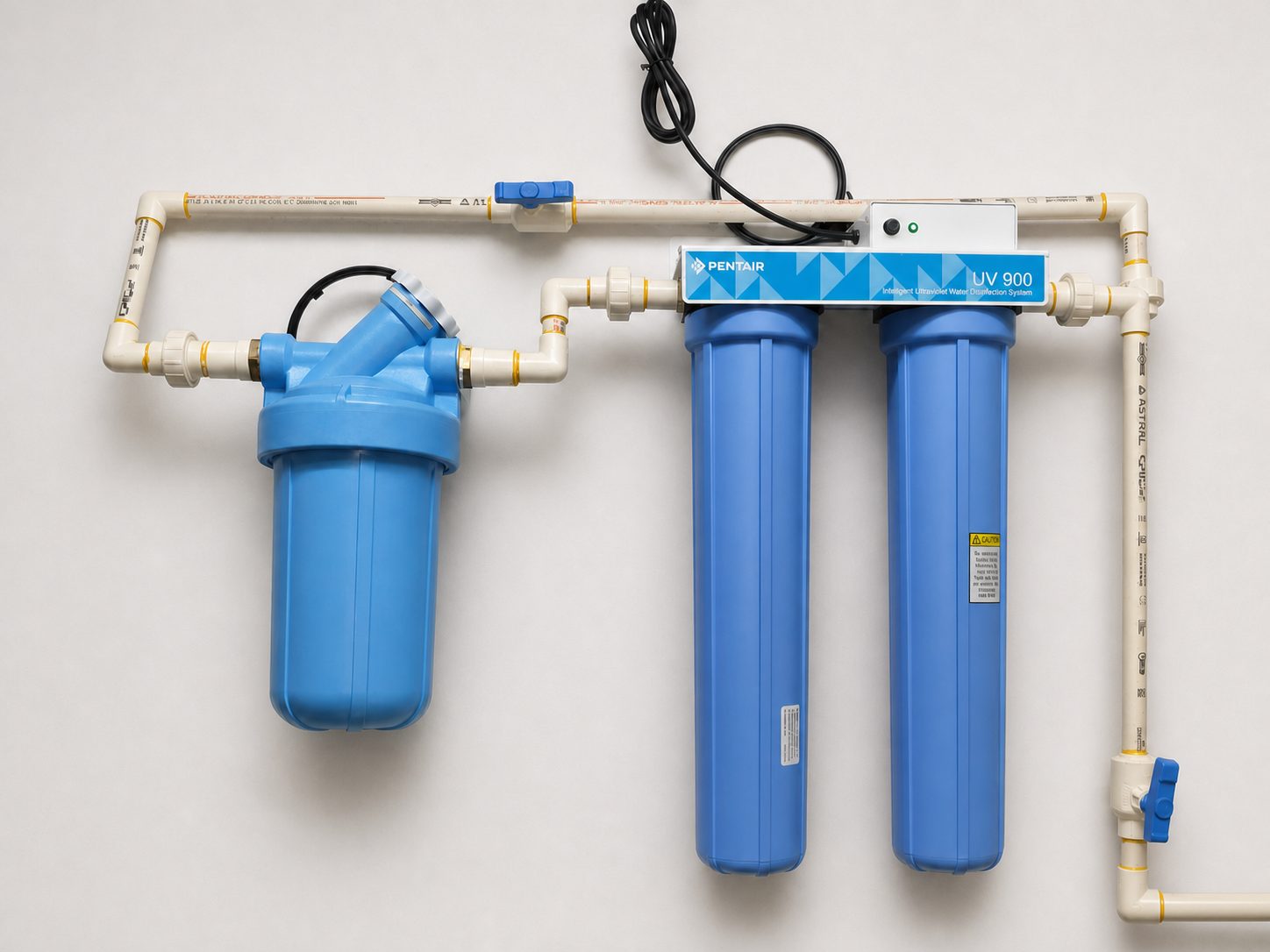
UV can inactivate microorganisms when the selected unit delivers the required dose and the water has suitable UV transmittance. It does not remove TDS or hardness. WHO guidance notes that excessive turbidity and certain dissolved species can inhibit UV disinfection; WHO's technical treatment table recommends keeping turbidity below 1 NTU to support effective disinfection, or below 5 NTU with higher fluence where the lower level is impractical. [Source: WHO Guidelines for Drinking-water Quality, treatment table]
Unlike a residual chemical disinfectant, UV does not leave continuing disinfectant protection in downstream storage and piping. Hygienic tanks, closed distribution, cleaning, and monitoring therefore remain important.
Step 4: Size for peak demand, not only average daily use
Plant capacity should be calculated from a documented demand profile.
At minimum, establish:
- total treated-water demand per day;
- the highest demand during the busiest hour or service window;
- how many hours the plant can realistically operate;
- usable treated-water storage;
- simultaneous equipment demand;
- inlet pressure and available electrical supply;
- planned downtime for regeneration, backwashing, sanitation, or service; and
- future expansion or a second outlet, where relevant.
A basic planning relationship is:
That calculation is only the starting point. An engineer must also account for the treatment system's usable output under the measured feed-water conditions, storage turnover, peak draw, and any regeneration or backwash interruptions.
For operations that cannot tolerate a loss of soft water or pressure during service, redundancy may be more important than simply installing a larger vessel or pump.
Step 5: Design the plant room and distribution—not just the treatment skid
A technically suitable plant can still fail operationally if the site is not ready for it.
Check the following before finalising the system:
- floor space and maintenance clearance;
- drainage for backwash, regeneration, flushing, and RO concentrate;
- electrical load, earthing, and protection;
- raw- and treated-water tank hygiene;
- safe chemical and salt handling;
- ventilation and heat exposure;
- inlet and delivery pressure;
- food-grade or otherwise application-suitable wetted materials;
- clearly identified raw-water and treated-water sampling points;
- isolation valves and a controlled bypass arrangement;
- pipe routing that avoids dead legs where practicable; and
- access for cartridge replacement, membrane cleaning, resin service, lamp replacement, and instrument calibration.
In hot Indian plant rooms or outdoor installations, verify the equipment's allowable ambient and feed-water temperature range with the manufacturer. Do not assume that a system rated under one set of test conditions will provide the same output under every site's temperature, pressure, and TDS.
Step 6: Commission with evidence
Commissioning should prove that the installed system performs as intended. A useful handover pack includes:
- approved process flow and equipment schedule;
- raw-water laboratory report;
- commissioning readings at defined operating conditions;
- treated-water laboratory report where required;
- flow, pressure, TDS/conductivity, hardness, and disinfectant or UV checks relevant to the design;
- valve positions and operating instructions;
- consumables and spare-parts list;
- cleaning, sanitation, regeneration, and replacement schedule;
- escalation contacts; and
- warranty and AMC scope.
TDS alone is not an adequate commissioning certificate. The acceptance tests should reflect the actual risks and performance objectives established during design.
Step 7: Plan maintenance before the restaurant opens
Treatment performance changes as cartridges load, carbon exhausts, softeners regenerate, membranes foul, tanks accumulate deposits, and UV lamps age. Maintenance intervals therefore should be based on manufacturer requirements, measured throughput, feed-water quality, pressure differential, monitoring data, and sanitary risk—not an arbitrary calendar date alone.
At minimum, the operating log should record:
- raw- and treated-water TDS or conductivity where relevant;
- hardness before and after a softener where relevant;
- inlet, outlet, and differential pressure;
- product and reject flow for RO systems;
- cartridge and media replacement dates;
- softener salt use and regeneration observations;
- UV alarm or intensity status where provided;
- tank cleaning and sanitation;
- laboratory-test dates; and
- faults, corrective actions, and parts replaced.
Seven common planning mistakes
- Buying an RO plant before testing the water. RO may be justified, underspecified, or unnecessary depending on the verified water and application.
- Treating TDS as a complete water-safety test. It is one physical-chemical measure, not proof of microbiological safety.
- Using one water specification for every machine. Coffee, ice, steam, and warewashing equipment can have different manufacturer limits.
- Sizing only from average daily demand. Peak service demand and available production time govern whether the kitchen runs short.
- Ignoring storage and distribution hygiene. Treated water can be compromised after treatment.
- Providing no drain, bypass control, or service clearance. A maintainable plant needs a maintainable site.
- Treating handover as the end of the project. Monitoring, consumables, sanitation, and preventive maintenance are part of reliable water treatment.
A practical pre-project checklist
Before requesting a commercial water-treatment proposal, collect:
- restaurant city and exact site;
- water source or combination of sources;
- recent raw-water laboratory report;
- operating hours and covers per service;
- application-wise demand: drinking, cooking, ice, coffee, steam, warewashing, and utilities;
- equipment list with manufacturer water specifications;
- existing tanks, pumps, plumbing, and treatment equipment;
- available plant-room space, power, and drainage;
- present problems such as scale, taste, odour, sediment, pressure drop, or downtime; and
- planned opening date and future expansion.
Frequently asked questions
Does every restaurant need a commercial RO plant?
No. RO is selected when the source-water analysis and application requirements justify membrane separation. A restaurant may require filtration, carbon, softening, UV, RO, or a combination. Selecting RO without testing can lead to unnecessary water and energy use or fail to address the actual problem.
Is low TDS always better for restaurant water?
No. TDS is neither a complete safety measure nor a universal quality score. Different beverage and equipment applications may require a controlled mineral range, while potable-water safety requires assessment against the applicable drinking-water parameters. Follow the equipment manufacturer's specification and the engineered treatment objective.
Can a water softener replace an RO system?
Not generally. A softener primarily addresses calcium- and magnesium-related hardness. RO separates a much broader range of dissolved substances. They solve different problems and are sometimes used together.
Can UV remove hardness or TDS?
No. UV is a disinfection process; it does not physically remove dissolved minerals. Its performance also depends on water clarity, UV transmittance, dose, lamp condition, and system design.
How often should a restaurant test its water?
Follow the current FSSAI requirement, licence conditions, applicable local requirements, and the testing provisions relevant to the source. FSSAI's current food-service hygiene checklist includes semi-annual testing language and specific provisions for municipal and privately supplied potable water. Additional sampling may be prudent after a source change, treatment modification, contamination event, abnormal result, or material seasonal shift.
Plan the system around your water and your kitchen
The right restaurant water-treatment system is not the one with the longest equipment list. It is the one that connects verified source-water quality, application-specific requirements, peak demand, site constraints, commissioning evidence, and a maintainable operating plan.
DhwaNeer designs and executes commercial water-treatment projects for restaurants, hotels, commercial kitchens, corporate facilities, and utilities. The process begins with water analysis and site assessment, followed by technical design, supply, installation, commissioning, and ongoing AMC support.
Sources
This article was fact-checked on 18 July 2026 using the primary and technical sources below.
- FSSAI: Hygiene requirements and Schedule 4 overview
- FSSAI: Food Service Establishment Hygiene Rating Checklist
- Government of India: Uniform Drinking Water Quality Monitoring Protocol and selected IS 10500 parameters
- Bureau of Indian Standards: Drinking Water IS 10500 product manual
- Central Ground Water Board: Annual Ground Water Quality Report 2025
- World Health Organization: Guidelines for Drinking-water Quality
- WHO: Water quality and health—review of turbidity
- US EPA: Overview of drinking-water treatment technologies
- NSF: Standards for water-treatment systems
- Pentair Everpure: Foodservice Product Reference Guide